You might know you need support, but the thought of saying the words out loud makes your chest tighten. You may open a message, type a few words, delete them, and then tell yourself you are being silly. You may convince yourself that other people have it worse, that you should cope, that you should wait until you can explain it properly. But pain does not always arrive in neat sentences.
Sometimes it shows up as overwhelm. Sometimes it looks like silence. Sometimes it feels like sitting with your phone in your hand, wanting someone steady to reach back, but not knowing where to begin. That is one of the reasons I built The Anchor Line.
I wanted to create a gentle form of support for people who may not feel ready for a phone call, a video session, or a full coaching conversation. I wanted there to be another way in. Something calmer. Something quieter. Something that still felt human.
Because support should not only be available to people who can speak clearly when they are struggling. In this post, I want to share why I created The Anchor Line, who it is for, and why text-based support can feel so powerful for people affected by trauma, emotional overwhelm, difficult relationships, or simply the weight of carrying too much for too long.
You do not have to be ready for a full conversation to deserve support
Why I Built The Anchor Line
I built The Anchor Line because I know that asking for support can feel huge.
Not mildly uncomfortable. Not a little awkward. Huge.
For some people, sending one message can take every bit of courage they have that day. They may have spent hours, weeks, or even years telling themselves that they should be fine. They may have learnt to minimise their own feelings. They may have become so used to being the strong one that reaching out feels almost wrong.
And when trauma, abuse, anxiety, or emotional overwhelm sits underneath that, the first step can feel even harder.
I have spoken to people who do not know where to start. I have met people who feel stuck but cannot explain why. I have supported people who feel exhausted from carrying everything, yet still worry they are asking for too much.
That matters to me.
The key takeaway is this: The Anchor Line exists because not everyone feels able to speak before they feel safe.
An anchor does not rush you forward. It simply helps you steady
It helps you make sense of your experiences
Some people need time before words come. Some people need space to think. Some people need to type, pause, breathe, read it back, and then decide whether they want to send it.
That does not make their need for support any less real.
In fact, I think it shows how much care we need to take when we offer support. We cannot assume that everyone feels comfortable with the same format. We cannot assume that a phone call feels simple. We cannot assume that a video session feels safe. We cannot assume that someone who goes quiet does not need help.
Sometimes the person who needs support most is the person who cannot ask for it loudly.
That is where The Anchor Line comes in.
But in real life, healing often starts much smaller.
I wanted to offer something steady and accessible. A place where someone could send a message without feeling they had to perform, explain everything perfectly, or have a full plan for what they needed.
Because sometimes the message is simply:
“I don’t know what to do.”
Or:
“I feel overwhelmed.”
Or:
“I just need someone to help me slow down.”
And those messages deserve care.
I did not build The Anchor Line to replace deeper support. I built it to create a softer first step. A bridge. A way for someone to reach out when talking feels too much, but staying alone with it feels too heavy.
There is something powerful about written words. They give us room. They do not rush us in quite the same way. They can help us name what is happening one sentence at a time.
For someone whose nervous system feels on high alert, that slower pace can make a difference. A phone call may feel too exposing. A video session may feel too intense. Sitting across from someone may feel impossible. But sending a message from the sofa, the car, the kitchen table, or the edge of the bed may feel just about manageable.
And sometimes “just about manageable” is exactly where support needs to begin.
Another key takeaway is this: support does not have to feel overwhelming to be meaningful.
It can start with one honest sentence.
It can start with admitting, “I am not okay today.”
It can start with someone replying calmly, without judgment, without pressure, and without making you feel like a burden.
That is the heart of The Anchor Line.
I wanted to create a line back to steadiness. Not a place where anyone needs to have all the answers. Not a place where anyone has to tell their whole story. Not a place where anyone has to be “ready” in a polished or perfect way.
Just a place to begin.
Because when someone has been through trauma, control matters. Choice matters. Pace matters. Feeling believed matters. Being met gently matters.
I never want support to feel like another demand.
I want it to feel like a breath.
A pause.
A handrail.
A reminder that you do not have to carry the whole thing alone.
“Sometimes healing begins with one honest message: I’m not okay today.”
YOU MATTER
The name The Anchor Line
The name The Anchor Line felt right because an anchor does not drag you forward before you are ready. It does not shout instructions from the shore. It does not ask you to explain why the water feels rough.
It simply helps you steady.
And for many people, that is the first thing they need.
Not fixing. Not pushing. Not pressure.
Steadiness.
When I built The Anchor Line, I thought about the person who has spent all day pretending they are fine. The person who cannot cry until everyone else has gone to bed. The person who feels confused after a difficult relationship. The person who keeps replaying a conversation. The person who feels guilty for having needs. The person who wants support but feels nervous about booking a full session.
I wanted them to have another option.
A quieter option.
A human option.
A way to say, “I need support,” without having to say it out loud.
GENTLE SUPPORT
You do not have to keep working through it on your own.
Trauma-informed coaching can offer a calm, supportive space to reflect, rebuild, and move forward at a pace that feels safe for you. You can begin where you are.
Lana Elliott is a trauma-informed life coach and wellbeing writer. Lana supports adults affected by trauma, difficult life experiences, and domestic abuse through calm, client-led coaching and gentle, trauma-informed resources.
When Saying Yes Is a Survival Strategy: People-Pleasing as a Trauma Response
There’s something I want you to know — if you’ve spent your whole life putting everyone else first, it might not be because you’re “just a nice person”…
What People-Pleasing Really Is
There’s something I want you to know — if you’ve spent your whole life putting everyone else first, it might not be because you’re “just a nice person.” It might be because, somewhere along the way, being agreeable became the safest thing you could do.
I know, because I’ve been there.
For years, I said yes to things I didn’t want to do. I smiled when I was hurting. I made myself smaller so other people could feel bigger. And I thought that was just who I was — a people-pleaser, a giver, someone who cared too much.
But the truth is, people-pleasing wasn’t a personality trait. It was a survival strategy. And it took me a long time to understand the difference.
When we grow up in environments where expressing our needs was unsafe — where saying no led to anger, punishment, withdrawal of love, or worse — we learn to read the room. We learn to anticipate what other people want before they even ask. We learn that the safest version of ourselves is the one that causes the least disruption.
This is called fawning, and it’s actually a trauma response — just like fight, flight, or freeze. It’s the nervous system’s way of keeping us safe by making us agreeable, accommodating, and invisible.
The trouble is, what kept us safe as children can quietly destroy us as adults.
People-pleasing was not a personality trait. It was a survival strategy.
The Hidden Cost of Always Saying Yes
People-pleasing might look generous from the outside. But underneath, it often feels like exhaustion, resentment, and a slow disappearing act.
You might recognise some of these feelings:
You feel responsible for everyone else’s emotions. If someone around you is upset, you immediately feel like it’s your fault — or your job to fix it.
You struggle to say no. Even when you’re running on empty, the thought of disappointing someone feels physically uncomfortable.
You don’t know what you actually want. You’ve spent so long tuning in to other people’s needs that your own have gone quiet.
You feel guilty for resting. Doing nothing feels selfish, even when your body is begging you to stop.
You attract people who take more than they give. Because you’ve been trained to over-give, you may find yourself in relationships that feel one-sided.
If you’re nodding along, please hear me — this isn’t a flaw. This is your nervous system doing exactly what it learned to do. And the beautiful thing is, what was learned can be unlearned.
Why It’s So Hard to Stop
Here’s the part that nobody really talks about: stopping people-pleasing can feel genuinely terrifying.
When your survival has depended on keeping others happy, the idea of prioritising yourself can trigger a deep, physical sense of danger. Your body might react with panic, guilt, or shame — not because you’re doing something wrong, but because you’re doing something unfamiliar.
This is why willpower alone doesn’t work. You can’t just decide to stop people-pleasing and expect your nervous system to get on board overnight. It’s not a mindset problem — it’s a body-level pattern that needs gentle, patient rewiring.
And that’s okay. Healing doesn’t have to happen all at once.
What kept you safe as a child can quietly exhaust you as an adult.
Small Steps Toward Putting Yourself Back in the Picture
If you’re reading this and thinking, “But where do I even start?” — I want to offer you some gentle starting points. Not a complete overhaul, just small, brave steps.
1. Start Noticing
Before you change anything, just notice. When you say yes to something, pause and ask yourself: Do I actually want to do this, or am I afraid of what happens if I don’t?
There’s no judgment here. Just awareness. That awareness alone is a powerful first step.
2. Practice the Pause
You don’t have to answer immediately. When someone asks you for something, try saying: “Let me think about that and get back to you.” It’s a complete sentence. You don’t owe an instant response.
This tiny pause creates space between the request and your automatic “yes” — and in that space, you get to choose.
3. Let Go of Over-Explaining
When you do say no, you don’t need to justify it with a list of reasons. “I can’t do that” or “That doesn’t work for me” are enough. I know it feels uncomfortable, but the more you practise, the more natural it becomes.
4. Get Curious About Guilt
Guilt will show up — probably a lot. But try to get curious about it rather than letting it drive your decisions. Ask yourself: Is this guilt telling me I’ve done something wrong, or is it just telling me I’ve done something unfamiliar?
Most of the time, it’s the latter.
5. Start With the Small Things
You don’t have to set a huge boundary with the most difficult person in your life tomorrow. Start small. Choose where you want to eat. Say you’d prefer a different time. Admit that you’re tired and need to rest.
These small acts of honesty build the muscle for bigger ones later.
6. Find Safe People
Recovery from people-pleasing is so much easier when you have even one person who makes it safe to be yourself — someone who won’t punish you for having needs. That might be a friend, a support worker, or a coach. You deserve to be around people who don’t require you to shrink.
You Were Never “Too Much” — You Were Just Surviving
If there’s one thing I want to leave you with, it’s this: the fact that you’ve spent your life looking after everyone else doesn’t mean you’re weak. It means you found a way to survive something bigger than you.
But you’re not in that situation anymore. And you’re allowed to take up space now. You’re allowed to have needs. You’re allowed to say no without apologising. You’re allowed to choose yourself — not instead of everyone else, but as well as everyone else.
That’s not selfish. That’s healing.
And if you’re not sure where to start, or you just need someone to sit with you while you figure it out — I’m here. That’s exactly what my coaching is for. Gentle, trauma-informed, no pressure. Just a safe space to begin finding your way back to yourself.
You can reach out to me at [lanaelliottwellbeing.co.uk](https://lanaelliottwellbeing.co.uk) whenever you’re ready.
If you or someone you know is affected by domestic abuse, support is available:
National Domestic Violence Helpline: 0808 2000 247 (24 hours, freephone)
You are allowed to take up space. You are allowed to say no.
YOUR NEEDS MATTER TOO
GENTLE SUPPORT
You do not have to keep working through it on your own.
Trauma-informed coaching can offer a calm, supportive space to reflect, rebuild, and move forward at a pace that feels safe for you. You can simply begin where you are.
Lana Elliott is a trauma-informed life coach and wellbeing writer. Lana supports adults affected by trauma, difficult life experiences, and domestic abuse through calm, client-led coaching and gentle, trauma-informed resources.
Through both her coaching and her writing, Lana aims to create spaces where people feel seen, heard, and supported as they begin to heal and move forward.
Healthy Boundaries
If you have experienced trauma, the idea of setting boundaries can feel frightening.
You may know that boundaries are healthy. You may have read about them. You may have even encouraged others to set them. But when it comes to your own life, it feels different. You might freeze when you need to assert yourself. You might worry that saying no will upset someone. You might fear conflict, rejection, or backlash. You might feel guilty before you’ve even spoken about healthy boundaries. .
For many survivors, guilt is the main barrier. The moment you think about setting a limit, guilt arrives: you may feel selfish, rude, like a burden, or responsible for someone else’s disappointment, as though you are doing something wrong.
If this sounds familiar, it does not mean you are weak. It often means boundaries were not safe for you at some point.
In many unsafe environments, boundaries were ignored, mocked, punished, or used as a reason to withdraw love. In abusive relationships, a boundary might have triggered anger, silent treatment, guilt-tripping, or control. In some families, having needs was seen as “dramatic” or “difficult”. In those settings, it makes sense that boundaries would feel risky now.
This article will explore what boundaries really are, why guilt can feel so strong, and how to set boundaries in a trauma-informed way that protects your wellbeing without turning you into someone you are not.
What Boundaries Really Are
A boundary is not a wall. A boundary is not an attack. A boundary is not a punishment.
A boundary is a clear limit that safeguards your well-being.
It answers questions like, “What works for me?” What doesn’t? What can I handle right now? What do I need to feel safe and respected?
Boundaries can be physical, emotional, digital, time-based, or practical. They might involve what you will talk about, how often you reply, how you spend your time, or what behaviour you will not accept.
Many people perceive boundaries as severe. But healthy boundaries can be gentle. They can be composed. They can be subtle. They can be compassionate.
The purpose of a boundary is not to control other people. The purpose is to take care of yourself.
Boundaries can be firm, clear, and respectful at the same time.
Daring to set boundaries is about having the courage to love ourselves even when we risk disappointing others.
Why Boundaries Can Feel So Hard After Trauma
For trauma survivors, boundaries can activate the nervous system.
When you consider declining or speaking up, your body may react as if danger is imminent. You might feel your heart pound. You might feel your stomach sink. You might be at a loss for words. You might feel unsteady. You might feel compelled to joke or retreat.
This is not because boundaries are inappropriate. It is because your nervous system has learned that boundaries carry consequences.
If you have been punished for voicing needs, your body may associate boundaries with threat. If you have been blamed for disputes, you may fear that establishing a limit will make you responsible for problems. If you have been abandoned or rejected after asserting yourself, you may fear that boundaries will result in loss of affection.
Unhealthy dynamics can make boundaries feel frightening and unsafe.
Writing down your boundaries can help bring clarity and confidence.
These fears are not irrational. They are rooted in experience. Even if your current relationships are safer, your nervous system may still react with old protective responses.
This is why boundaries are not just a communication skill. They are also a safety skill.
Why Guilt Shows Up So Fast
Guilt is a powerful emotion. It can stop you from protecting yourself even when you need to.
For trauma survivors, guilt often appears for a few reasons.
One reason is conditioning: if you grew up being called selfish for having needs, guilt becomes automatic. Another is responsibility—many survivors were forced to manage other people’s moods and learned that keeping others happy was their job. Now, setting a boundary can trigger guilt because you are no longer doing that job.
Another reason is fear. Sometimes guilt is not genuine guilt. It is fear disguised as guilt. It is the nervous system warning, “This might not be safe.
It also helps to recognise that guilt can come from empathy. If you care about others, you may naturally notice how your boundary affects them. That is not a bad thing. The issue is when empathy becomes self-abandonment.
Healthy boundaries allow compassion without losing yourself.
Healthy Boundaries and Kindness Can Exist Together
Many people fear that boundaries make them cold.
This fear is understandable, especially if you have spent a lifetime being “nice” to stay safe. If you have survived by being agreeable, boundaries can feel like cruelty.
But boundaries are not harsh. They are certain.
It is possible to be kind and say no, to care and need space, to be loving and still protect yourself.
In fact, boundaries often make relationships healthier. Without boundaries, resentment builds. Burnout happens. People feel unseen. Over time, relationships can break down, not because anyone is bad, but because limits were never honoured.
Boundaries keep relationships honest. They allow steadier closeness, rather than one that drains you.
The Difference Between a Request and a Demand
This is an important shift in boundary work.
A request is something someone can ask for, but you can say yes or no. A demand is something that comes with punishment if you say no.
Trauma can blur this difference. If you have lived in controlling environments, your nervous system may treat every request like a demand. Someone asks for your time, and your body reacts as if you must provide it. Someone asks you to talk, and your body reacts as if you have no choice. Someone wants help, and your body reacts as if saying no is dangerous.
Part of healing is teaching your nervous system that you now have a choice.
You are allowed to pause. You are allowed to think. You are allowed to say no.
If someone punishes you for saying no, that is not a request. That is control.
Trauma-Informed Boundaries Start With Awareness
Before you set boundaries with others, it helps to notice where you struggle.
Some people struggle with time boundaries—replying too fast, saying yes too quickly, and becoming overwhelmed. Others struggle with emotional or physical boundaries, taking on feelings or tolerating discomfort, which can leave them drained.
A trauma-informed approach starts with noticing your body.
When someone asks you for something, what happens inside? Do you feel pressure to agree? Do you feel anxious? Do you feel a sinking feeling? Do you feel dread? Do you feel tightness in your chest?
These signals are not random. They are information. They can help you recognise when a boundary is needed.
Many survivors were taught to ignore their bodies. Boundary work often involves learning to listen to it again.
The Pause: A Simple Tool That Changes Everything
One of the most effective boundary tools is the pause.
People-pleasing often happens quickly. The yes comes out before you have checked in with yourself. You may agree automatically and later feel regret.
The pause interrupts that pattern.
Instead of answering right away, you can say, “Let me think, and I’ll get back to you,” “I’ll check my diary,” “I’m not sure yet,” or “Can I let you know later?”
This pause gives your nervous system time to settle. It gives your true answer time to appear. It also teaches others that your time and energy are valuable.
You do not owe an instant reply.
Gentle Ways to Say No Without Over-Explaining
Many trauma survivors feel they must justify their no.
They worry that if they do not provide a good enough reason, they will be rejected or attacked. So they over-explain. They apologise repeatedly. They give long stories. They offer alternatives that they cannot manage.
Over-explaining often comes from fear.
Healthy boundaries can be simple.
You can say, “I can’t do that.”
You can say, “That doesn’t work for me.”
You can say, “I’m not available.”
You can say, “I need rest.”
You can say, “I can’t commit to that.”
You can also add warmth without overdoing it. You might say, “Thank you for asking, but I can’t.” You might say, “I care, but I need some time to myself.” You might say, “I’m keeping things simple at the moment.”
You do not have to convince someone. In healthy relationships, your no is enough.
No is a complete sentence
Boundaries Are About Actions, Not Arguments
A boundary is strongest when it focuses on what you will do.
Instead of arguing or explaining for a long time, you can calmly state your limit and what will happen next.
For example, you might say, “I’m not able to talk about that topic. If it comes up, I will change the subject or end the call.” You might say, “I don’t take calls after 8pm. If you call then, I’ll reply the next day.”
This is not harsh. It is clear.
If you have been in relationships where your words were ignored, action-based boundaries can feel safer. You are not begging someone to respect you. You are taking care of yourself.
Handling Guilt When You Set a Boundary
Even when you set a boundary kindly, guilt may still appear.
It helps to remember that guilt is not always a sign of wrongdoing. Sometimes guilt is a sign that you are breaking an old rule, such as “My needs don’t matter” or “I must keep everyone happy.”
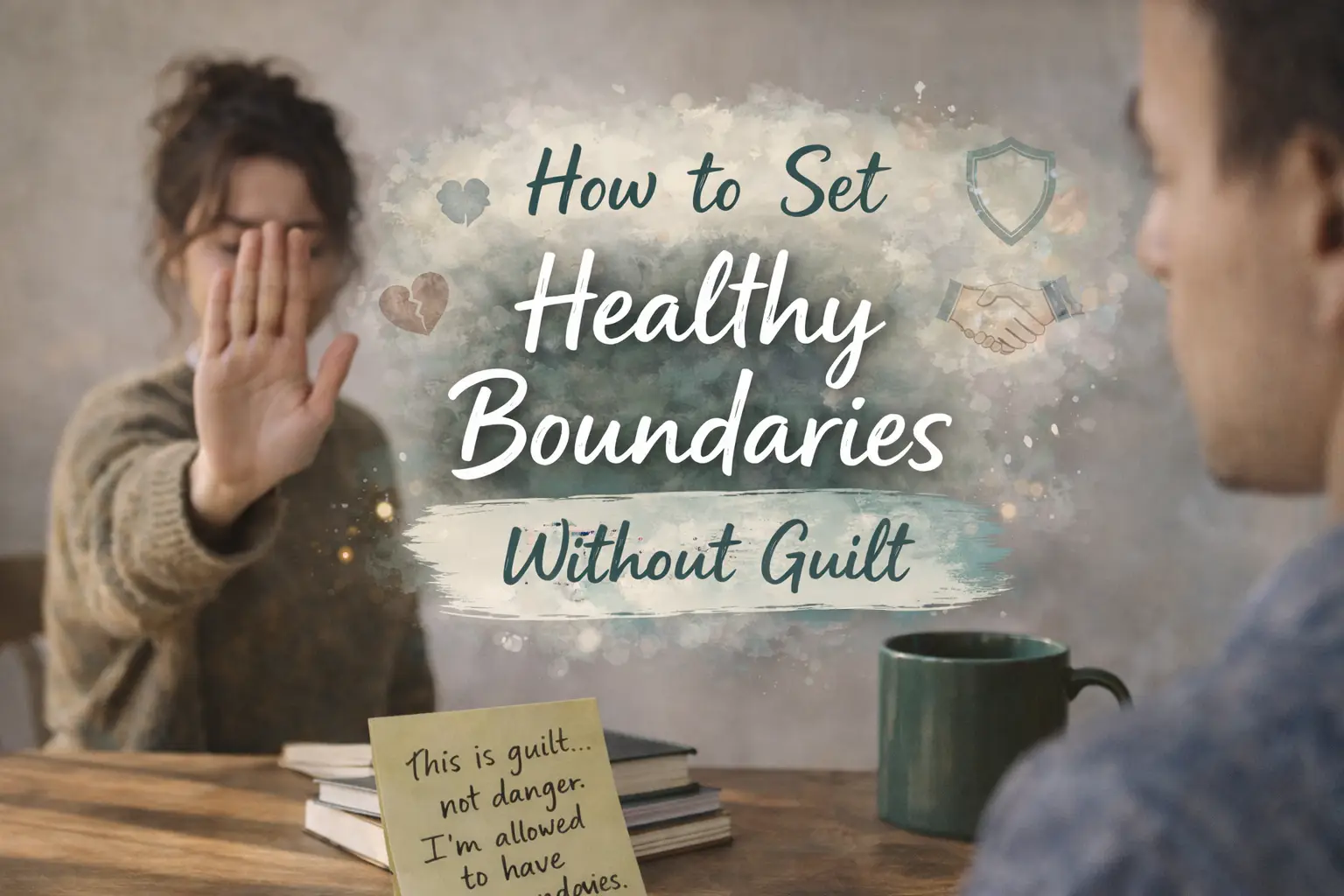
You can work with guilt by naming it softly. You might tell yourself, “This is guilt, not danger.” You might tell yourself, “It is okay to feel guilty and still keep my boundary.” You might tell yourself, “My body is learning something new.”
You can also remind yourself of the cost of not having boundaries. Without boundaries, you may become exhausted. You may become resentful. You may withdraw. You may lose your energy and joy. Boundaries protect your long-term well-being.
Guilt may feel uncomfortable, but discomfort is not the same as harm.
What If Someone Dislikes Your Boundary?
This is one of the hardest parts.
Some people will not like your boundaries. That does not automatically mean you are wrong.
Disappointment is a normal emotion. People can feel disappointed and still respect you. A healthy person may say, “Okay,” even if it is not what they wanted.
If someone reacts with anger, guilt-tripping, insults, threats, or the silent treatment, that is not a healthy way to handle disappointment. That is manipulation or control.
Trauma survivors often fear reactions because reactions used to mean danger. It can help to watch for behaviour rather than feelings.
A safe person respects your boundary. An unsafe person punishes you for it.
You deserve relationships where you can be a full human being, not just a helper.
Boundaries in Close Relationships
Many people find it hardest to set boundaries with partners, family, or close friends.
These relationships can carry history. They can also carry expectations. You may fear losing connection. You may fear being seen as ungrateful. You may fear being labelled selfish.
In close relationships, boundaries often work best when they are calm and consistent.
If you set a boundary one day and drop it the next, your nervous system stays unsettled, and others may become confused as well. Consistency helps everyone adjust.
It can also help to name the boundary as a form of care. You might say, “I’m setting this boundary because I want our relationship to feel healthy.” You might say, “I’m doing this so I don’t burn out.” You might say, “I care about you, and I need rest too.”
Healthy people can usually hear this.
Boundaries With Yourself Matter Too
Trauma-informed boundaries are not only about other people. They are also about you.
You may need boundaries around your own habits, especially if you tend to push yourself too hard.
This might include resting before you crash. It might include limiting doom-scrolling or overworking. It might include saying no to your own inner critic when it tells you you must prove your worth.
You can practise self-boundaries by asking, “What is realistic for me today?” and “What would support my body right now?”
This is not laziness. It is nervous system care.
Boundaries Are a Form of Healing
Every time you set a boundary, you send your nervous system a message.
You are telling yourself, “I matter.”
You are telling yourself, “I am allowed to have limits.”
You are telling yourself, “I do not have to earn rest.”
You are telling yourself, “I can protect myself now.”
This is powerful, especially for survivors who were not protected in the past.
Boundaries can feel shaky at first. That is normal. Healing often feels awkward at the beginning because it is new.
With time and practice, boundaries begin to feel less like conflict and more like self-respect.
Final Thoughts
Healthy boundaries are not selfish. They are necessary.
If guilt shows up when you set a limit, it does not mean you are doing something wrong. It often means you are doing something different from what you had to do in the past.
You are allowed to say no. You are allowed to rest. You are allowed to protect your time, energy, and emotional space. You are allowed to have relationships that do not depend on you overgiving.
Boundaries are not about pushing people away. They are about letting people be close to you in a way that feels safe.
And you do not have to learn this alone.
Thank you for taking the time to read my blog. If it resonated with you, please consider sharing it so others may benefit too.