Author: admin

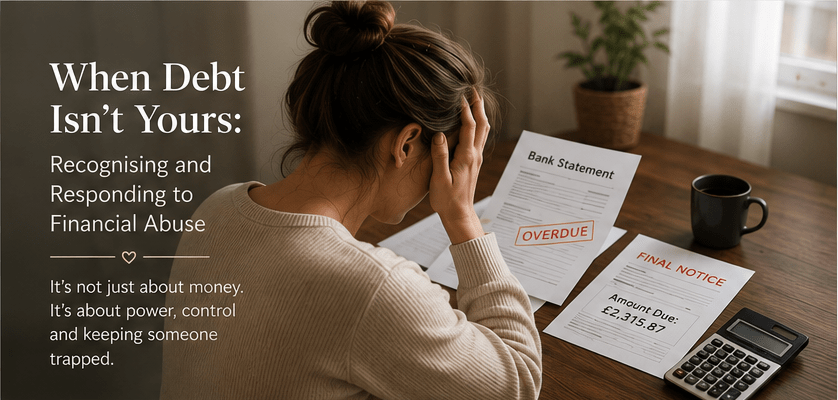
  • When Debt Isnโ€™t Yours: 10 Signs of Financial Abuse and What You Can Do About It.

    When Debt Isnโ€™t Yours: 10 Signs of Financial Abuse and What You Can Do About It.


    Financial abuse is one of the most hidden forms of domestic abuse.

    It does not always look dramatic from the outside. It may not involve visible injuries. It may not begin with someone taking every penny from your account. Sometimes it starts with โ€œIโ€™ll look after the money.โ€ Sometimes it sounds like โ€œYouโ€™re useless with spending.โ€ Sometimes it is a loan, a phone contract, a car finance agreement, a joint account, a missed payment, or a bill you were told not to worry about until it lands in your name.


    But financial abuse is not really about money.
    It is about power, control, freedom and safety.


    In July 2026, Refuge reported a 78% rise in referrals involving technology-facilitated abuse and economic abuse, including growing concerns around perpetrators exploiting car finance agreements and leaving survivors in serious debt. UK charities, including Refuge and Surviving Economic Abuse, have warned that perpetrators are increasingly using loans, finance, digital tools and credit systems as part of coercive control.
    This matters because financial abuse can keep someone trapped long after the relationship has ended. It can affect housing, credit scores, employment, confidence, mental health and the ability to rebuild safely.


    If you have ever thought, โ€œBut the debt is in my name, so maybe it is my fault,โ€ this article is for you.


    What is financial abuse?


    Financial abuse, also known as economic abuse, happens when someone uses money, debt, property, employment, benefits, bills, transport, technology or financial systems to control another person.


    Surviving Economic Abuse explains that economic abuse is a legally recognised form of domestic abuse in England and Wales under the Domestic Abuse Act 2021. It involves control over money and finances, but also the things money can buy, such as housing, food, transport, phones and everyday essentials.


    It can happen during a relationship, after separation, within marriage, between ex-partners, or within family relationships. It can happen alongside emotional abuse, coercive control, physical abuse, sexual abuse or technology-facilitated abuse.
    It can also be very difficult to explain.


    A survivor may say:


    โ€œI donโ€™t know how it happened.โ€
    โ€œI thought I agreed to it at the time.โ€
    โ€œThey said it was for us.โ€
    โ€œI was scared to say no.โ€
    โ€œI didnโ€™t understand what I was signing.โ€
    โ€œThey told me I would ruin everything if I refused.โ€
    โ€œI thought I was helping.โ€


    This is why trauma-informed understanding matters. Financial abuse is not always a neat, simple story. It is often built through fear, pressure, manipulation, shame and confusion.


    Why financial abuse is often missed


    Financial abuse is often missed because people still have a narrow idea of what domestic abuse looks like.


    Many people picture shouting, bruises or police call-outs. They may not picture someone being prevented from working. They may not notice a partner monitoring bank transactions. They may not recognise the danger in someone being forced to take out credit, hand over benefits, justify every purchase, or carry debt for something they did not freely choose.


    The Home Office and Surviving Economic Abuse published figures in June 2026 showing gaps in public understanding, including that younger men were more likely than older men to fail to recognise controlling how someone spends money as abuse.
    That gap matters. If people do not recognise financial control as abuse, survivors are more likely to blame themselves. Friends and family may dismiss it as โ€œrelationship problemsโ€ or โ€œbad budgeting.โ€ Professionals may focus only on the debt rather than the coercion behind it.


    Financial abuse is not poor money management when someone else has been controlling, pressuring, threatening or sabotaging your financial choices.
    It is abuse.


    10 signs of financial abuse


    Financial abuse can look different in every relationship, but these are common warning signs.


    1. They control access to money


    This might mean they hold the bank cards, control online banking, decide what you are โ€œallowedโ€ to spend, or give you small amounts of money while keeping the rest.
    You may have to ask for basic things. You may feel anxious buying food, toiletries, petrol, clothes for the children, medication or anything for yourself.
    The issue is not whether a couple has shared finances. Many couples do. The issue is whether one person has choice, information and freedom, while the other person has control.


    2. They monitor or question every purchase


    Some perpetrators demand receipts, check bank apps, look through messages, question every transaction or accuse the survivor of lying.
    This can leave someone feeling watched all the time.
    Even small purchases can become frightening because the survivor knows there may be an argument, punishment, silent treatment, threats or accusations later.


    3. They stop you from working, studying or becoming independent


    Financial abuse may involve stopping someone from going to work, sabotaging childcare, causing arguments before shifts, hiding keys, interfering with study, or making it impossible to keep a job.
    Sometimes it is direct: โ€œYouโ€™re not working.โ€
    Sometimes it is disguised as care: โ€œYou donโ€™t need to work. Iโ€™ll look after you.โ€
    Sometimes it is emotional pressure: โ€œIf you loved me, youโ€™d stay home.โ€
    The result is the same. Your independence becomes smaller.


    4. They take out credit, loans or finance in your name


    This can include loans, credit cards, overdrafts, phone contracts, catalogues, car finance agreements or other forms of borrowing.
    Sometimes the survivor is pressured to apply. Sometimes they are misled. Sometimes they sign because they are scared of what will happen if they refuse. Sometimes the debt is taken without full understanding or genuine consent.
    Surviving Economic Abuse describes coerced debt as debt caused by an abusive partner or ex-partner, or debt someone has been forced to take on because of abuse.
    This is one of the reasons the phrase โ€œdebt in your nameโ€ does not always tell the full story.


    5. They use technology to control your finances


    Technology-facilitated abuse can include monitoring banking apps, tracking spending, accessing emails, using passwords, controlling phone accounts, checking location, or using digital tools to intimidate or restrict someone.
    Refuge has a specialist tech safety resource for people worried about issues such as phone monitoring, online stalking or digital abuse by a partner or ex-partner.
    Technology can make abuse feel constant because the perpetrator does not need to be physically present to keep control.


    6. They build debt and then blame you for it


    A perpetrator may pressure someone into debt, spend money, refuse to contribute, drain joint funds, or create financial chaos โ€” then blame the survivor.
    They may say:
    โ€œYou agreed to it.โ€
    โ€œYouโ€™re the reason weโ€™re in this mess.โ€
    โ€œYouโ€™re useless with money.โ€
    โ€œNo one will believe you.โ€
    This can cause deep shame. It can also make survivors delay seeking help because they feel embarrassed or afraid of being judged.
    StepChange reported in March 2026 that seven in ten victim-survivors did not seek help with coerced debt, with shame, embarrassment and not knowing what help was available among the reasons given.
    That statistic is important because it shows how silence protects the abuse, not the survivor.


    7. They control benefits, wages or household income


    Financial abuse can involve taking someoneโ€™s wages, benefits, child maintenance or other income. It may also include forcing them to transfer money, open accounts, hand over cards, or explain why they need access to their own money.
    For survivors who rely on benefits, disability support, carersโ€™ allowance, child benefit or other income, this can create a serious safety risk. Losing access to money can mean losing access to transport, food, medication, phone credit, appointments and escape options.


    8. They use money to punish you


    Money may be used as a reward or punishment.
    The perpetrator might withhold money after an argument, refuse to pay bills, cancel cards, stop paying rent, threaten to leave you with debt, or make you beg for essentials.
    This is not a normal disagreement about budgeting. It is control.


    9. They make it harder for you to leave


    Financial abuse is one of the reasons leaving can be so difficult.
    A survivor may not have savings, transport, access to documents, a safe phone, a good credit score, secure housing or enough money to get through the first few days. They may be carrying debt they did not freely choose. They may fear homelessness, court action, debt collectors, losing the car, or being unable to provide for children.
    This is why comments like โ€œWhy didnโ€™t you just leave?โ€ are harmful.
    Leaving is not only an emotional decision. It can be a financial, legal, housing and safety issue.


    10. They continue financial abuse after separation


    Financial abuse does not always stop when the relationship ends.
    Post-separation abuse can involve refusing to pay agreed costs, using child maintenance as control, dragging out legal processes, leaving joint debts unpaid, sending abusive payment references, damaging credit scores or using shared financial responsibilities to maintain contact.


    Recent UK banking changes show that this is being taken more seriously. For example, Nationwide introduced measures allowing customers to hide harmful messages sent through payment references, after concerns that abusers were using banking systems to continue harassment.
    This matters because abuse can continue through systems that were not designed with survivor safety in mind.


    Why financial abuse affects trauma and mental health


    Financial abuse does not only affect bank accounts.


    It can affect the nervous system, confidence, decision-making and sense of self.
    Someone experiencing financial abuse may feel constantly on edge. They may panic when a bill arrives. They may avoid opening letters. They may feel sick when checking their bank account. They may struggle to make decisions because every decision has previously been criticised, monitored or punished.


    They may also experience shame.


    Shame is one of the most powerful tools in abuse. If someone feels ashamed, they are less likely to tell anyone. If they feel responsible for the debt, they may not ask for help. If they believe professionals will judge them, they may stay silent until the situation becomes urgent.


    A trauma-informed response does not begin with โ€œWhy did you sign it?โ€ or โ€œWhy didnโ€™t you leave?โ€


    It begins with:
    โ€œWhat pressure were you under?โ€
    โ€œWhat did you feel would happen if you said no?โ€
    โ€œWho had the power in that situation?โ€
    โ€œWhat support would help you feel safer now?โ€


    This does not remove responsibility from financial systems, lenders, agencies or perpetrators. It simply puts the survivorโ€™s experience back into context.


    What to do if this sounds familiar


    If any of this sounds familiar, you do not need to have all the answers today.
    You do not need to prove everything before you deserve support.
    You do not need to wait until the situation is โ€œbad enough.โ€


    Financial abuse can be confusing because it often happens gradually. You may only recognise it once you are exhausted, frightened, in debt, isolated or trying to rebuild.
    Here are some safer first steps to consider.


    Notice the pattern


    Try to look at the pattern rather than one single incident.
    Ask yourself:


    Do I feel free to make financial choices?
    Do I have access to my own money?
    Am I scared of their reaction when I spend money?
    Have I been pressured into debt, finance or contracts?
    Do they use money to control, punish or monitor me?
    Has my financial situation become worse because of their behaviour?


    You do not have to label everything immediately. Noticing the pattern can be the first step.


    Keep records where it is safe


    If it is safe to do so, keep records of messages, bank statements, agreements, threats, payment references, debts, contracts or anything that shows pressure or control.
    Do not do this if it increases your risk. If someone monitors your phone, email, cloud storage or online banking, speak to a specialist service about safer ways to keep information.


    Get specialist advice


    Economic abuse can involve domestic abuse support, debt advice, legal advice, housing advice and safety planning.


    Womenโ€™s Aid lists the Financial Support Line for Victims of Domestic Abuse, run by Surviving Economic Abuse and Money Advice Plus, as a specialist service for the financial side of domestic abuse.


    Surviving Economic Abuse also provides information for people experiencing coerced debt, including options around debt and credit reports.


    If you are in immediate danger, call 999.


    Avoid confronting the perpetrator without support


    It can be tempting to challenge them once you recognise the abuse.
    But if someone is controlling, confrontation can increase risk.
    A safer approach may be to speak to a domestic abuse service, debt adviser, solicitor, trusted professional or helpline before making changes they may notice.
    Safety comes before speed.


    Remember that shame is not proof of fault


    Many survivors feel ashamed because the debt is in their name, because they stayed. They signed something, because they did not understand what was happening, or because they feel they โ€œshould have known.โ€
    But coercion changes the meaning of choice.


    A decision made under fear, pressure, manipulation, exhaustion or threat is not the same as a free decision.


    You are allowed to seek help even if the paperwork looks complicated.
    You are allowed to say, โ€œThis was not as simple as it looks.โ€


    Why professionals need to understand financial abuse


    Financial abuse is not only something survivors need to recognise. Professionals need to recognise it too.


    That includes coaches, writers, healthcare workers, debt advisers, housing teams, social care professionals, therapists, bank staff, HR teams, legal professionals and anyone supporting people in crisis.


    The UK Governmentโ€™s Economic Abuse Toolkit for public sector creditors says that noticing the signs and offering consistent, effective support can have a significant impact on someoneโ€™s safety and economic stability.
    That sentence matters.


    It means the response someone receives can either increase shame or reduce it. It can either focus only on the debt or ask what caused it. It can either treat someone as irresponsible or recognise that abuse may have restricted their choices.


    A trauma-informed professional response should be:
    curious, not blaming;
    clear, not overwhelming;
    practical, not dismissive;
    safety-aware, not rushed;
    respectful of choice, not forceful.


    Someone experiencing financial abuse may already have been told they are stupid, careless, dramatic, irresponsible or impossible to help. Professionals must not repeat the perpetratorโ€™s message in a different voice.


    Where to get financial abuse support in the UK


    If you are experiencing domestic abuse or financial abuse, you deserve support that understands the risk and complexity.
    Useful UK starting points include:


    Refuge and the 24-hour National Domestic Abuse Helpline. https://refuge.org.uk/i-need-help-now/how-we-can-help-you/our-refuges/


    Surviving Economic Abuse for information on economic abuse, coerced debt and financial safety.


    Womenโ€™s Aid for survivor information and routes to specialist support. https://womensaid.org.uk/


    The Financial Support Line for Victims of Domestic Abuse, run by Surviving Economic Abuse and Money Advice Plus, for specialist financial guidance.


    NHS guidance on getting help for domestic violence and abuse also explains that domestic abuse can include physical, emotional and sexual abuse, and can happen in close or trusted relationships.


    If you are in immediate danger, call 999.


    If it is not safe to search for support on your own device, consider using a safer device, clearing browsing history, using a trusted professional, or contacting a specialist domestic abuse service for tech safety guidance.


    Final thoughts


    Financial abuse is not โ€œjust money.โ€


    It can affect where you live, how safe you feel, whether you can leave, whether you can work, whether you can feed yourself, whether you can access transport, whether you can answer the phone without fear, and whether you believe a future is possible.
    If debt was created through fear, pressure, control or manipulation, the story is bigger than the balance owed.


    You are not weak for feeling overwhelmed.
    You are not irresponsible for needing help.
    And you are not alone if it has taken time to recognise what was happening.


    At Lana Elliott Wellbeing, I write and speak about trauma, domestic abuse and recovery in a way that keeps the person at the centre. Financial abuse deserves to be understood because survivors deserve more than judgment. They deserve safety, information, choice and support that sees the full picture.

    GENTLE SUPPORT

    You do not have to keep working through it on your own.

    Trauma-informed coaching can offer a calm, supportive space to reflect, rebuild, and move forward at a pace that feels safe for you. You can begin where you are.


    Lana Elliott is a trauma-informed life coach and wellbeing writer. Lana supports adults affected by trauma, difficult life experiences, and domestic abuse through calm, client-led coaching and gentle, trauma-informed resources.


    LANA ELLIOTT WELLBEING

  • Writing as Therapy: Journaling for Trauma Healing

    Writing as Therapy: Journaling for Trauma Healing

    WELLBEING

    Writing as Therapy: Journaling for Trauma Healing

    Writing as Therapy: Journaling for Trauma Healing

    Why Writing Helps When Words Feel Stuck

    Focus Keyword: journaling for trauma healing Secondary Keywords: writing therapy, trauma recovery, journal prompts, emotional healing, mental health journaling, therapeutic writing, self-care, processing trauma Suggested URL: /writing-as-therapy-journaling-for-trauma-healing

    Trauma has a way of silencing us. Whether it is the lingering effects of abuse, a difficult childhood, grief, or any experience that left a deep mark โ€” trauma often gets trapped in the body and the mind with nowhere to go. You might find that you cannot quite explain how you feel. Or you know something is wrong, but the words just will not come. That is where journaling comes in. Writing gives your thoughts and feelings a place to land. It does not require you to say anything out loud, explain yourself to anyone, or even make sense of what you write. You just need a pen and some paper โ€” or a notes app on your phone โ€” and a few minutes of honesty with yourself. Journaling for trauma healing is not about being a good writer. It is not about grammar or spelling or producing something anyone else will read. It is about permitting yourself to feel, to process, and to let some of what you are carrying out of your head and onto the page.

    Writing gives your thoughts somewhere to land. It can turn chaos into clarity.

    The Science Behind Therapeutic Writing

    There is solid research behind the idea that writing about difficult experiences can improve


    both mental and physical health. Psychologist James Pennebaker has studied expressive writing for decades, and his research consistently shows that writing about emotional upheaval can reduce anxiety, improve mood, and even strengthen the immune system. When we experience trauma, the memory of that event is often stored differently in the brain compared to ordinary memories.

    Traumatic memories can feel fragmented โ€” more like a collection of sensations, images, and emotions than a coherent story. This is one reason why trauma can feel so overwhelming and confusing.


    Writing helps to organise these fragments. When you put your experience into words, you are essentially moving it from the emotional part of your brain to the part that processes language and logic. This does not erase the memory or make the pain disappear, but it can reduce the intensity of the emotions attached to it. It helps your brain file the experience in a way that feels more manageable.


    Studies have also shown that regular journaling can lower cortisol levels โ€” the hormone your body produces when you are stressed. Over time, this can help reduce the physical symptoms that often come with trauma, such as difficulty sleeping, tension headaches, and fatigue.

    How Journaling Supports Trauma Recovery

    There are several specific ways that journaling can support your healing journey.

    Understanding these can help you see journaling not as a chore, but as a genuine tool for

    recovery.

    It creates distance from overwhelming emotions

    When difficult feelings are spinning around in your head, they can feel all-consuming. Writing

    them down creates a small but important distance between you and your emotions. Once

    the words are on the page, they are outside of you. You can look at them, sit with them, and

    even walk away from them for a while. That distance can bring a sense of relief you might

    not expect.

    You do not need to be a writer to benefit from journaling. You just need to be honest.

    It helps you make sense of your experiences

    Trauma is often chaotic. It does not follow a neat storyline. Journaling allows you to piece

    things together at your own pace. You do not need to start at the beginning or write

    chronologically. You might write about a feeling one day, a memory the next, and something

    seemingly unrelated the day after that. Over time, patterns and connections often emerge

    naturally.

    It helps you make sense of your experiences

    It gives you a safe space to be honest

    Many people who have experienced trauma have had their feelings dismissed, minimised, or

    used against them. The thought of opening up to someone else can feel terrifying. Your

    journal does not judge you. It does not tell you to calm down or get over it. It holds whatever

    you need to say, exactly as you need to say it.

    There is no right way to journal. There is only your way.

    YOUR WORDS MATTER

    It tracks your progress

    When you are in the middle of healing, it can feel like nothing is changing. But if you journal regularly and look back at earlier entries, you will often notice shifts you could not see in the moment. Maybe you are sleeping slightly better. Maybe a situation that would have sent you spiralling three months ago now only causes a ripple. These small changes matter, and your journal is the evidence.

    It builds self-awareness

    Journaling helps you notice your own patterns โ€” the triggers that set you off, the thoughts that spiral, the situations that drain you, and the things that bring you comfort. This awareness is powerful because it puts you in a position to make more intentional choices about how you respond to the world around you.

    Getting Started: Practical Tips

    If you have never journaled before, or if the idea of writing about trauma feels daunting, here are some practical tips to help you get started without putting too much pressure on yourself. Start small. You do not need to write pages and pages. Five minutes is enough. Even a few sentences count. The point is to build the habit, not to produce a masterpiece. If all you write is “today was hard, and I do not know why,” that is a perfectly valid entry.

    Choose what feels comfortable

    Some people prefer a physical notebook โ€” the act of handwriting can feel grounding and intentional. Others prefer typing because it is quicker and feels less permanent. There is no right or wrong way. Use whatever feels most comfortable for you. Do not censor yourself. Your journal is private. Nobody else needs to see it. Write exactly what you are thinking and feeling without worrying about whether it makes sense, whether it is fair, or whether it sounds dramatic. Let it be messy. Let it be raw. That is the whole point.

    Try timed writing

    Set a timer for ten minutes and write without stopping. Do not lift your pen from the page or take your fingers off the keyboard. If you run out of things to say, write “I do not know what to write” until something comes. This technique, sometimes called freewriting, is brilliant for getting past the inner critic that tells you your feelings are not worth putting down.

    Use prompts if you need them

    If staring at a blank page feels too open, journal prompts can give you a starting point. Here are a few to try: What emotion am I carrying today, and where do I feel it in my body? What is something I needed to hear as a child but never did?

    If my anxiety could talk, what would it say?

    What does safety feel like to me? What am I proud of myself for today, even if it seems small? Write a letter to your younger self. What would you want them to know? What boundary do I need to set, and what is stopping me?

    Describe a moment recently when you felt calm. What made it possible?

    Write at a time that works for you. Some people like to journal first thing in the morning to clear their head before the day starts. Others prefer the evening as a way to process what happened during the day. There is no best time โ€” just the time that you are most likely to actually do it.

    What to Do If Writing Brings Up Difficult Feelings

    It is important to be honest about this: journaling about trauma can sometimes bring up intense emotions. That does not mean you are doing it wrong. It means the writing is doing what it is supposed to do โ€” bringing things to the surface so they can be processed. โ€ข โ€ข โ€ข โ€ข โ€ข โ€ข โ€ข โ€ข

    However, if you find that journaling is leaving you feeling significantly worse, overwhelmed, or distressed, it is okay to step back. You do not have to push through. Here are some things that can help: Ground yourself after writing. Do something physical โ€” make a cup of tea, step outside, feel the cold water on your hands.

    This helps bring you back to the present moment. Set a timer. Give yourself a fixed amount of time to write and then stop. This prevents you from going too deep without a boundary. Write about the present too. Not every entry needs to be about trauma. Write about your day, your breakfast, your dog, and the weather. Mix it up. Talk to someone. If your writing has brought something up that feels too big to hold alone, reach out to a trusted person or a professional. Journaling is a powerful tool, but it is not a replacement for professional support when you need it.

    Journaling and Professional Support

    Journaling works best when it sits alongside other forms of support, not as a replacement for them. If you are working with a life coach, therapist, or counsellor, your journal can be a valuable companion to that work. You might find that things come up in your writing that you want to explore in your sessions. Or your coach might suggest specific prompts or exercises to try between meetings. A trauma-informed life coach can also help you build a journaling practice that feels safe and sustainable. If you have experienced trauma, having someone to guide you through the process โ€” someone who understands the complexities of healing โ€” can make the practice feel less overwhelming and more purposeful.

    Different Types of Journaling to Try

    There is no single right way to journal, and experimenting with different approaches can help you find what works best for you. Here are a few types of journaling that are particularly useful for trauma recovery: Stream of consciousness writing. This is the simplest form โ€” write whatever comes to mind without stopping or editing. It is particularly good for getting unstuck and for accessing thoughts and feelings that you might not even know you have. โ€ข โ€ข โ€ข โ€ข Gratitude journaling. Writing down three things you are grateful for each day might sound simple, but it can genuinely shift your focus over time. This is not about ignoring the hard stuff โ€” it is about training your brain to notice the good alongside the bad. Letter writing. Writing letters you never send can be incredibly therapeutic. You might write to your younger self, to someone who hurt you, or to someone you have lost. The act of putting those words on paper can provide a sense of closure or release that you cannot get any other way. Reflective journaling. At the end of each day or week, write about what happened, how you felt, and what you noticed about yourself. This builds self-awareness and helps you spot patterns in your thoughts and behaviour over time.

    Making Journaling a Long-Term Habit

    Like any habit, journaling gets easier the more you do it. But it is also worth saying that you do not need to do it every single day for it to be valuable. Some weeks, you might write every morning. Other weeks, you might not pick up your journal at all. That is fine. What matters is that you come back to it.

    Here are a few ways to keep the habit going:

    Keep your journal somewhere visible so it serves as a gentle reminder. Pair it with something you already do โ€” write while you drink your morning coffee, or before bed. Do not judge your entries โ€” no entry is too short, too messy, or too trivial. Look back at old entries from time to time to remind yourself how far you have come. Your healing journey is yours. There is no timeline, no rulebook, and no one right way to do it. But if you are looking for a tool that is free, private, and entirely in your control, journaling is one of the most powerful things you can do for yourself. Your story matters. Even the parts you have never told anyone. Especially those parts. โ€ข โ€ข โ€ข โ€ข Lana Elliott is a trauma-informed life coach who supports people through healing from trauma, abuse, and difficult life experiences. www.

    GENTLE SUPPORT

    You do not have to keep working through it on your own.

    Trauma-informed coaching can offer a calm, supportive space to reflect, rebuild, and move forward at a pace that feels safe for you. You can begin where you are.


    WRITTEN BY LANA ELLIOTT

    Lana Elliott is a trauma-informed life coach and wellbeing writer. Lana supports adults affected by trauma, difficult life experiences, and domestic abuse through calm, client-led coaching and gentle, trauma-informed resources.

    LANA ELLIOTT WELLBEING

  • The Anchor Line Support When You Need It

    The Anchor Line Support When You Need It

    WELLBEING

    Why I Built The Anchor Line

    There are moments when talking feels impossible.

    You might know you need support, but the thought of saying the words out loud makes your chest tighten. You may open a message, type a few words, delete them, and then tell yourself you are being silly. You may convince yourself that other people have it worse, that you should cope, that you should wait until you can explain it properly.
    But pain does not always arrive in neat sentences.

    Sometimes it shows up as overwhelm. Sometimes it looks like silence. Sometimes it feels like sitting with your phone in your hand, wanting someone steady to reach back, but not knowing where to begin.
    That is one of the reasons I built The Anchor Line.


    I wanted to create a gentle form of support for people who may not feel ready for a phone call, a video session, or a full coaching conversation. I wanted there to be another way in. Something calmer. Something quieter. Something that still felt human.


    Because support should not only be available to people who can speak clearly when they are struggling.
    In this post, I want to share why I created The Anchor Line, who it is for, and why text-based support can feel so powerful for people affected by trauma, emotional overwhelm, difficult relationships, or simply the weight of carrying too much for too long.

    You do not have to be ready for a full conversation to deserve support

    Why I Built The Anchor Line

    An anchor does not rush you forward. It simply helps you steady

    It helps you make sense of your experiences

    Some people need time before words come. Some people need space to think. Some people need to type, pause, breathe, read it back, and then decide whether they want to send it.

    That does not make their need for support any less real.

    But in real life, healing often starts much smaller.

    I wanted to offer something steady and accessible. A place where someone could send a message without feeling they had to perform, explain everything perfectly, or have a full plan for what they needed.


    Because sometimes the message is simply:


    โ€œI donโ€™t know what to do.โ€


    Or:


    โ€œI feel overwhelmed.โ€


    Or:


    โ€œI just need someone to help me slow down.โ€


    And those messages deserve care.


    I did not build The Anchor Line to replace deeper support. I built it to create a softer first step. A bridge. A way for someone to reach out when talking feels too much, but staying alone with it feels too heavy.


    There is something powerful about written words. They give us room. They do not rush us in quite the same way. They can help us name what is happening one sentence at a time.


    For someone whose nervous system feels on high alert, that slower pace can make a difference.
    A phone call may feel too exposing. A video session may feel too intense. Sitting across from someone may feel impossible. But sending a message from the sofa, the car, the kitchen table, or the edge of the bed may feel just about manageable.


    And sometimes โ€œjust about manageableโ€ is exactly where support needs to begin.


    Another key takeaway is this: support does not have to feel overwhelming to be meaningful.

    โ€œSometimes healing begins with one honest message: Iโ€™m not okay today.โ€

    a pink water background with a book pen cup and throw offering text based support

    YOU MATTER

    The name The Anchor Line

    The name The Anchor Line felt right because an anchor does not drag you forward before you are ready. It does not shout instructions from the shore. It does not ask you to explain why the water feels rough.

    GENTLE SUPPORT

    You do not have to keep working through it on your own.

    Trauma-informed coaching can offer a calm, supportive space to reflect, rebuild, and move forward at a pace that feels safe for you. You can begin where you are.


    WRITTEN BY LANA ELLIOTT

    Lana Elliott is a trauma-informed life coach and wellbeing writer. Lana supports adults affected by trauma, difficult life experiences, and domestic abuse through calm, client-led coaching and gentle, trauma-informed resources.

    LANA ELLIOTT WELLBEING

  • When Saying Yes Is a Survival Strategy

    When Saying Yes Is a Survival Strategy

    WELLBEING

    When Saying Yes Is a Survival Strategy: People-Pleasing as a Trauma Response

    There’s something I want you to know โ€” if you’ve spent your whole life putting everyone else first, it might not be because you’re “just a nice person”…

    When Saying Yes Is a Survival Strategy: People-Pleasing as a Trauma Response

    What People-Pleasing Really Is

    There’s something I want you to know โ€” if you’ve spent your whole life putting everyone else first, it might not be because you’re “just a nice person.” It might be because, somewhere along the way, being agreeable became the safest thing you could do.

    I know, because I’ve been there.

    For years, I said yes to things I didn’t want to do. I smiled when I was hurting. I made myself smaller so other people could feel bigger. And I thought that was just who I was โ€” a people-pleaser, a giver, someone who cared too much.

    But the truth is, people-pleasing wasn’t a personality trait. It was a survival strategy. And it took me a long time to understand the difference.

    When we grow up in environments where expressing our needs was unsafe โ€” where saying no led to anger, punishment, withdrawal of love, or worse โ€” we learn to read the room. We learn to anticipate what other people want before they even ask. We learn that the safest version of ourselves is the one that causes the least disruption.

    This is called fawning, and it’s actually a trauma response โ€” just like fight, flight, or freeze. It’s the nervous system’s way of keeping us safe by making us agreeable, accommodating, and invisible.

    The trouble is, what kept us safe as children can quietly destroy us as adults.

    People-pleasing was not a personality trait. It was a survival strategy.

    The Hidden Cost of Always Saying Yes

    People-pleasing might look generous from the outside. But underneath, it often feels like exhaustion, resentment, and a slow disappearing act.

    You might recognise some of these feelings:

    • You feel responsible for everyone else’s emotions. If someone around you is upset, you immediately feel like it’s your fault โ€” or your job to fix it.
    • You struggle to say no. Even when you’re running on empty, the thought of disappointing someone feels physically uncomfortable.
    • You don’t know what you actually want. You’ve spent so long tuning in to other people’s needs that your own have gone quiet.
    • You feel guilty for resting. Doing nothing feels selfish, even when your body is begging you to stop.
    • You attract people who take more than they give. Because you’ve been trained to over-give, you may find yourself in relationships that feel one-sided.

    If you’re nodding along, please hear me โ€” this isn’t a flaw. This is your nervous system doing exactly what it learned to do. And the beautiful thing is, what was learned can be unlearned.

    The Hidden Cost of Always Saying Yes

    Why It’s So Hard to Stop

    Here’s the part that nobody really talks about: stopping people-pleasing can feel genuinely terrifying.

    When your survival has depended on keeping others happy, the idea of prioritising yourself can trigger a deep, physical sense of danger. Your body might react with panic, guilt, or shame โ€” not because you’re doing something wrong, but because you’re doing something unfamiliar.

    This is why willpower alone doesn’t work. You can’t just decide to stop people-pleasing and expect your nervous system to get on board overnight. It’s not a mindset problem โ€” it’s a body-level pattern that needs gentle, patient rewiring.

    And that’s okay. Healing doesn’t have to happen all at once.

    What kept you safe as a child can quietly exhaust you as an adult.

    Small Steps Toward Putting Yourself Back in the Picture

    If you’re reading this and thinking, “But where do I even start?” โ€” I want to offer you some gentle starting points. Not a complete overhaul, just small, brave steps.

    1. Start Noticing

    Before you change anything, just notice. When you say yes to something, pause and ask yourself: Do I actually want to do this, or am I afraid of what happens if I don’t?

    There’s no judgment here. Just awareness. That awareness alone is a powerful first step.

    2. Practice the Pause

    You don’t have to answer immediately. When someone asks you for something, try saying: “Let me think about that and get back to you.” It’s a complete sentence. You don’t owe an instant response.

    This tiny pause creates space between the request and your automatic “yes” โ€” and in that space, you get to choose.

    3. Let Go of Over-Explaining

    When you do say no, you don’t need to justify it with a list of reasons. “I can’t do that” or “That doesn’t work for me” are enough. I know it feels uncomfortable, but the more you practise, the more natural it becomes.

    4. Get Curious About Guilt

    Guilt will show up โ€” probably a lot. But try to get curious about it rather than letting it drive your decisions. Ask yourself: Is this guilt telling me I’ve done something wrong, or is it just telling me I’ve done something unfamiliar?

    Most of the time, it’s the latter.

    5. Start With the Small Things

    You don’t have to set a huge boundary with the most difficult person in your life tomorrow. Start small. Choose where you want to eat. Say you’d prefer a different time. Admit that you’re tired and need to rest.

    These small acts of honesty build the muscle for bigger ones later.

    6. Find Safe People

    Recovery from people-pleasing is so much easier when you have even one person who makes it safe to be yourself โ€” someone who won’t punish you for having needs. That might be a friend, a support worker, or a coach. You deserve to be around people who don’t require you to shrink.

    You Were Never “Too Much” โ€” You Were Just Surviving

    If there’s one thing I want to leave you with, it’s this: the fact that you’ve spent your life looking after everyone else doesn’t mean you’re weak. It means you found a way to survive something bigger than you.

    But you’re not in that situation anymore. And you’re allowed to take up space now. You’re allowed to have needs. You’re allowed to say no without apologising. You’re allowed to choose yourself โ€” not instead of everyone else, but as well as everyone else.

    That’s not selfish. That’s healing.

    And if you’re not sure where to start, or you just need someone to sit with you while you figure it out โ€” I’m here. That’s exactly what my coaching is for. Gentle, trauma-informed, no pressure. Just a safe space to begin finding your way back to yourself.

    You can reach out to me at [lanaelliottwellbeing.co.uk](https://lanaelliottwellbeing.co.uk) whenever you’re ready.

    If you or someone you know is affected by domestic abuse, support is available:

    • National Domestic Violence Helpline: 0808 2000 247 (24 hours, freephone)
    • Refuge: [refuge.org.uk](https://www.refuge.org.uk)
    • In an emergency, always call 999.

    You are allowed to take up space. You are allowed to say no.

    YOUR NEEDS MATTER TOO

    GENTLE SUPPORT

    You do not have to keep working through it on your own.

    Trauma-informed coaching can offer a calm, supportive space to reflect, rebuild, and move forward at a pace that feels safe for you. You can simply begin where you are.


    WRITTEN BY LANA ELLIOTT

    Lana Elliott is a trauma-informed life coach and wellbeing writer. Lana supports adults affected by trauma, difficult life experiences, and domestic abuse through calm, client-led coaching and gentle, trauma-informed resources.

    LANA ELLIOTT WELLBEING

  • More Than Violence
What the Latest UK Domestic Abuse Figures Tell Us

    More Than Violence What the Latest UK Domestic Abuse Figures Tell Us

    Lana Elliott

    Through both her coaching and her writing, Lana aims to create spaces where people feel seen, heard, and supported as they begin to heal and move forward.

    Domestic abuse is more than physical violence โ€” and that matters, because so many people don’t realise what they’re living in until they’ve been living in it for years. Looking back on my own past relationships, I can now see patterns of abuse that at the time were completely invisible to me. There were no bruises. Nothing I could point to and say, “That is what this is.” And that’s exactly what makes it so hard to name. 

    It can include fear, control, threats, emotional abuse, financial abuse, sexual abuse, stalking, isolation, humiliation and coercive control. It can happen in intimate relationships or between family members. And it can affect anyone โ€” women, men, LGBTQ+ people, disabled people, older adults, young people and people from every background, in every kind of household.

    The latest UK domestic abuse figures show how widespread the issue remains. They also show a deeply worrying link between domestic abuse and suicide risk.

    It is important to be clear from the start. The figures do not show that more than half of all domestic abuse cases lead to suicide. That would not be accurate. What the latest figures do show is that, within recorded domestic abuse-related deaths, suspected suicides following domestic abuse are now a major and rising concern.

    In the year ending March 2025, the Crime Survey for England and Wales estimated that 3.8 million people aged 16 and over experienced domestic abuse. That is around 1 in 13 people. The Office for National Statistics also reported that around 12.5 million people aged 16 and over had experienced domestic abuse since the age of 16. That is around 1 in 4 people.

    The Domestic Homicide Project recorded 347 domestic abuse-related deaths in the year to March 2025 โ€” 150 of which were suspected suicides following domestic abuse, and 80 intimate partner homicides. Domestic abuse, in other words, can be life-threatening in ways that don’t always look like what we imagine when we picture danger. 

    Behind every statistic is a person. Someone who may have felt frightened. Someone who may have felt trapped. Someone who may have been controlled, isolated or worn down over time. Someone who deserved safety and support much earlier.

    This article looks at what the latest figures tell us, why domestic abuse can have such a huge impact on mental health, how to recognise the signs, and where people in the UK can get help.

    What counts as domestic abuse?


    Domestic abuse is not just physical violence.

    The NHS explains that domestic violence or abuse can include physical, emotional and sexual abuse in couple relationships or between family members. It can happen to anyone.

    Domestic abuse may include:

    • Threats involving children, pets, housing, money or immigration status
    • Physical violence
    • Threats or intimidation
    • Emotional abuse
    • Sexual abuse
    • Financial or economic abuse
    • Coercive control
    • Stalking
    • Digital monitoring
    • Isolation from friends or family
    • Humiliation
    • Controlling where someone goes, who they see or what they spend


    Some people know they are being abused. Others may feel confused. This is common when the abuse is mainly emotional or controlling.

    A person may think, โ€œThey have never hit me, so maybe it is not abuse.โ€ But abuse does not have to leave a bruise to be real.

    If someone is changing their behaviour because they are scared of another personโ€™s reaction, that matters. If someone feels watched, trapped, blamed or controlled, that matters too.

    two people shouting with letters coming out of their mouths
    Shouting can be abuse


    Domestic abuse will never end until we make it socially unacceptable.


    The latest UK domestic abuse figures


    The latest figures from the Office for National Statistics show that domestic abuse remains a major issue in England and Wales.

    For the year ending March 2025, the Crime Survey for England and Wales estimated that:

    • 3.8 million people aged 16 and over experienced domestic abuse in the last year.
    • This was around 7.8% of people aged 16 and over.
    • Around 2.2 million females and 1.5 million males experienced domestic abuse in the last year.
    • Around 12.5 million people have experienced domestic abuse since the age of 16.

    Police also recorded 1,350,460 domestic abuse-related incidents and crimes in England and Wales in the year ending March 2025. Of these, 816,493 were recorded as domestic abuse-related crimes.

    More information and figures can be found at the Office for National Statistics domestic abuse figures or by following the link below.

    These numbers are already high. But they are unlikely to show the full picture.


    Many people do not report domestic abuse to the Police. Some people are afraid that reporting will make the abuse worse. Some are worried they will not be believed. Some depend on the person harming them for money, housing, transport or childcare. Others may not yet recognise what is happening as abuse.

    Domestic abuse can be hidden for years. It can happen in homes that look calm from the outside. It can happen in relationships that other people think are โ€œnormalโ€. It can happen to people who seem confident, capable and successful.

    a lady upset with a man seemingly comforting her
    Things aren’t always as they seem.
    an idyllic looking home with 2 people arguing inside
    Noone truly knows what happens behind closed doors.


    Domestic abuse and suicide risk


    One of the most concerning findings from the latest domestic abuse-related death figures is the number of suspected suicides following domestic abuse.

    The Domestic Homicide Project recorded 347 domestic abuse-related deaths in the year to March 2025. This included 150 suspected suicides following domestic abuse. Reports also show that suspected suicides following domestic abuse have overtaken intimate partner homicides for the third year in a row.

    This does not mean that suicide is inevitable for survivors of domestic abuse. It is not. Many survivors do rebuild their lives, especially when they have safe support, protection, community and time.

    But the figures do show that domestic abuse can place a person under extreme emotional pressure.

    Abuse can make someone feel:

    • trapped
    • ashamed
    • frightened
    • watched
    • powerless
    • isolated
    • exhausted
    • responsible for the abuserโ€™s behaviour
    • unable to see a safe way forward

    This can be even harder when coercive control is involved.

    Coercive control is a pattern of behaviour. Used to dominate, frighten and limit another personโ€™s freedom. It can include threats, monitoring, isolation, financial control, emotional manipulation and punishment.

    A person living with coercive control may not feel able to make simple choices. They may feel they have to ask permission. They may feel unsafe saying no. They may feel that any attempt to leave will lead to danger, revenge or the loss of everything.

    Over time, this can affect a personโ€™s mental health deeply. It can lead to anxiety, depression, trauma symptoms, panic, sleep problems, shame, hopelessness and suicidal thoughts.

    This is why domestic abuse needs to be taken seriously, even when there are no physical injuries.

    Emotional abuse can be deeply damaging.

    Emotional abuse was the most common type of domestic abuse recorded by the Crime Survey for England and Wales for the year ending March 2025. The ONS reported that around 5.0% of people aged 16 and over experienced emotional abuse in the last year.

    Emotional abuse can include:

    • being constantly criticised
    • being blamed for everything
    • being called names
    • being humiliated in private or public
    • being told no one else would want you
    • being made to doubt your memory
    • being told you are โ€œtoo sensitiveโ€
    • being threatened
    • being ignored or punished with silence
    • being made to feel guilty for having needs
    • being made to feel responsible for the abuserโ€™s mood

    This type of abuse can slowly change how someone sees themselves.

    They may start to believe they are the problem. They may stop trusting their own judgement. They may feel they have to explain, apologise or prove themselves all the time.

    In my work as a trauma-informed life coach, this is one of the patterns I see most often. People arrive not always knowing they’ve been abused โ€” but knowing something has been deeply wrong with how they see themselves. The rebuilding often starts there, with simply being believed.

    Domestic abuse affects women and men.

    Domestic abuse can happen to anyone.

    The ONS estimated that, in the year ending March 2025, 2.2 million females and 1.5 million males experienced domestic abuse in England and Wales. The prevalence rates were 9.1% for females and 6.5% for males.

    Women are more likely to experience certain forms of severe and repeated abuse. Women are also more likely to be killed by a partner or ex-partner. But men can also experience domestic abuse, and their experiences should not be dismissed.

    Male victims may feel shame, fear or confusion. They may worry that people will not believe them. They may fear being laughed at or judged. They may also worry that services are not for them.

    Support is available for male victims too. The Menโ€™s Advice Line offers confidential advice, practical information and non-judgemental support for male victims of domestic abuse. It also welcomes trans and non-binary people who feel this is the right service for them.

    No one deserves abuse. Support should be available to anyone who is being harmed, controlled or frightened.

    Young people and domestic abuse

    Domestic abuse does not only happen in long-term adult relationships.

    The ONS reported that people aged 16 to 19 and 20 to 24 had higher levels of domestic abuse in the last year compared with people aged 25 and over.

    This matters because abuse in young relationships is sometimes minimised. It may be dismissed as jealousy, drama, immaturity or โ€œjust a bad relationshipโ€. But controlling behaviour is serious at any age.

    In young relationships, abuse may look like:

    • checking someoneโ€™s phone
    • demanding passwords
    • tracking someoneโ€™s location
    • pressuring someone sexually
    • threatening to share private images
    • isolating someone from friends
    • making someone prove where they are
    • constant messaging
    • Jealousy presented as love
    • threats of self-harm if the person leaves

    The Domestic Homicide Project has also recorded serious concerns around teenage relationship abuse, including the first formally recorded suspected suicide following teenage relationship abuse, where both the victim and suspect were under 18.

    Young people need clear, safe education about healthy relationships. They need to know that love should not feel like fear. They also need adults who will listen without judgment.

    Why people may not leave straight away

    One of the most harmful questions people ask about domestic abuse is, โ€œWhy didnโ€™t they just leave?โ€

    For me and many others, that shift in question โ€” from blame to curiosity โ€” can change everything. It’s a lifeline for anyone who has spent years feeling like they have to justify themselves. 

    Leaving is not always simple. In some cases, leaving can be the most dangerous time.

    A person may stay because:

    • They are afraid of what the abuser will do
    • They are threatened
    • They have nowhere safe to go
    • They have children
    • They depend on the abuser financially
    • They are worried about pets
    • They fear losing their home
    • They are being monitored
    • They have been isolated from support
    • They feel ashamed
    • They still love the person
    • They hope things will change
    • They have tried to leave before and were pulled back in

    Abuse can also create deep confusion. The same person who causes fear may also apologise, cry, promise change or show kindness afterwards. This can make the survivor feel torn.

    A trauma-informed response does not ask, โ€œWhy didnโ€™t you leave?โ€

    It asks, โ€œWhat made it unsafe or difficult to leave, and what support do you need now?โ€

    A woman sits on the edge of a bed, looking towards a partially open door, representing the fear, uncertainty and difficult choices that can make it hard to leave an abusive relationship.
    Leaving is not always simple. Fear, safety concerns and practical barriers can make walking away from abuse feel far more difficult than people often realise.

    Signs someone may be experiencing domestic abuse

    Someone may not say, โ€œI am being abused.โ€ They may not have the words yet. They may also be afraid the abuser will find out.

    Signs may include:

    • becoming withdrawn
    • cancelling plans often
    • seeming nervous around their partner or family member
    • needing permission to do things
    • having little access to money
    • being constantly checked on
    • unexplained injuries
    • sudden changes in confidence
    • becoming isolated
    • seeming exhausted or numb
    • being afraid to make decisions
    • always apologising
    • changing how they dress or behave
    • appearing anxious about getting home on time
    • saying their partner โ€œdoesnโ€™t likeโ€ certain friends or family members

    These signs do not prove abuse on their own. But they can be a reason to check in gently.

    You might say:

    โ€œIโ€™ve noticed you donโ€™t seem yourself lately. Iโ€™m not here to judge you, but Iโ€™m worried about you. Is anyone making you feel unsafe?โ€

    If they do open up, try not to rush them. Believe them. Stay calm. Let them know the abuse is not their fault.

    Safety planning and online safety

    If someone is experiencing domestic abuse, safety planning can be important.

    A safety plan may include:

    • keeping important documents somewhere safe
    • saving emergency numbers under a different name
    • keeping some money, medication or keys accessible if possible
    • planning where to go in an emergency
    • arranging a code word with a trusted person
    • speaking to a specialist domestic abuse service
    • thinking carefully before telling the abuser you are leaving
    • checking phone, app and location settings if safe to do so

    Online safety also matters.

    Some abusers monitor phones, emails, cloud accounts, social media, banking apps, location sharing, smart devices or search history. The NHS domestic abuse guidance notes that Womenโ€™s Aid provides information on how to cover your tracks online if you are worried someone may see that you have visited a domestic abuse webpage.

    If you are worried you are being monitored, it may be safer to use a trusted friendโ€™s phone, a work device, a library computer or another safe device when looking for help.

    Where to get help for domestic abuse in the UK

    If you are in immediate danger, call 999.

    If you cannot speak and you are calling from a mobile, the Silent Solution system may help. A recorded message will tell callers who cannot talk to press 55 to be put through to the Police.

    National Domestic Abuse Helpline

    The National Domestic Abuse Helpline, run by Refuge, is available on 0808 2000 247. Refuge states that the helpline offers confidential, non-judgemental support and information on your options, day or night.

    NHS domestic abuse guidance

    The NHS domestic abuse guidance explains what domestic abuse can look like, how to recognise signs, and where to get help. It also reminds people that domestic abuse can happen to anyone.

    Menโ€™s Advice Line

    The Menโ€™s Advice Line supports male victims of domestic abuse. It offers confidential advice, non-judgemental support, practical information and help.

    Galop

    Galop supports LGBT+ people experiencing abuse or violence, including domestic abuse, sexual violence, hate crime and other forms of harm. Galop lists its National Helpline for LGBT+ victims and survivors of abuse and violence as 0800 999 5428 and help@galop.org.uk.

    SignHealth Deaf Domestic Abuse Service

    SignHealth provides a specialist domestic abuse and sexual violence service for deaf people. It lists contact details as text only, 07800 003421 and email da@signhealth.org.uk.

    Samaritans

    If you feel unable to cope or are having suicidal thoughts, you can contact Samaritans on 116 123. This number is free to call in the UK.

    Asking for help is not weakness. It is the moment you begin choosing safety, support and yourself.

    How trauma-informed support can help

    Domestic abuse can affect a person long after the relationship or situation ends.

    A survivor may feel anxious, numb, disconnected, guilty, ashamed, angry or exhausted. They may struggle with trust, boundaries, sleep, confidence or decision-making. They may find themselves people-pleasing, over-explaining, freezing during conflict, or feeling responsible for other peopleโ€™s emotions.

    These responses are not signs of weakness. They are often survival responses.

    Trauma-informed support can help people begin to understand what has happened to them without blame. It can help survivors rebuild safety, self-trust and confidence at their own pace.

    This kind of support should never pressure someone to share more than they are ready to share. It should not judge them for staying, leaving, returning, feeling confused or needing time. Healing after abuse is not always simple. It is often a gradual process of feeling safe enough to reconnect with yourself again.

    This is the heart of the work I do with clients. Not rushing the process and not having an agenda for where someone should be. Just creating a space where it feels safe enough to start. 

    Domestic abuse is more than violence.

    Domestic abuse is more than violence.

    It is fear. It is control. It is isolation. It is meant to make you doubt yourself. It is being watched, blamed, threatened or worn down. It is living around someone elseโ€™s moods, reactions and rules.

    The latest UK figures show that domestic abuse remains widespread. They also show that the impact can be devastating, including the risk of suspected suicide following domestic abuse.

    But support is available.

    Something I want every person reading this to hear: you do not have to prove anything before reaching out. Not that it was bad enough. Not that you’re ready to leave. Not that you have a plan. One conversation โ€” just one โ€” can be the thing that changes everything. 

    If someone you care about may be experiencing abuse, you do not have to have all the answers. Listening, believing and helping them connect with specialist support can make a real difference.

    You are not alone. You are not to blame. You deserve safety, support and care. ๐Ÿ’™๐ŸŒฑ

    And always remember, you are not alone.


  • Protecting yourself with healthy boundaries

    Protecting yourself with healthy boundaries

    Lana Elliott

    Through both her coaching and her writing, Lana aims to create spaces where people feel seen, heard, and supported as they begin to heal and move forward.

    Healthy Boundaries

    If you have experienced trauma, the idea of setting boundaries can feel frightening.

    You may know that boundaries are healthy. You may have read about them. You may have even encouraged others to set them. But when it comes to your own life, it feels different. You might freeze when you need to assert yourself. You might worry that saying no will upset someone. You might fear conflict, rejection, or backlash. You might feel guilty before you’ve even spoken about healthy boundaries. .

    For many survivors, guilt is the main barrier. The moment you think about setting a limit, guilt arrives: you may feel selfish, rude, like a burden, or responsible for someone elseโ€™s disappointment, as though you are doing something wrong.

    If this sounds familiar, it does not mean you are weak. It often means boundaries were not safe for you at some point.

    In many unsafe environments, boundaries were ignored, mocked, punished, or used as a reason to withdraw love. In abusive relationships, a boundary might have triggered anger, silent treatment, guilt-tripping, or control. In some families, having needs was seen as โ€œdramaticโ€ or โ€œdifficultโ€. In those settings, it makes sense that boundaries would feel risky now.

    This article will explore what boundaries really are, why guilt can feel so strong, and how to set boundaries in a trauma-informed way that protects your wellbeing without turning you into someone you are not.

    What Boundaries Really Are


    A boundary is not a wall. A boundary is not an attack. A boundary is not a punishment.

    A boundary is a clear limit that safeguards your well-being.

    It answers questions like, “What works for me?” What doesn’t? What can I handle right now? What do I need to feel safe and respected?

    Boundaries can be physical, emotional, digital, time-based, or practical. They might involve what you will talk about, how often you reply, how you spend your time, or what behaviour you will not accept.

    Many people perceive boundaries as severe. But healthy boundaries can be gentle. They can be composed. They can be subtle. They can be compassionate.

    The purpose of a boundary is not to control other people. The purpose is to take care of yourself.

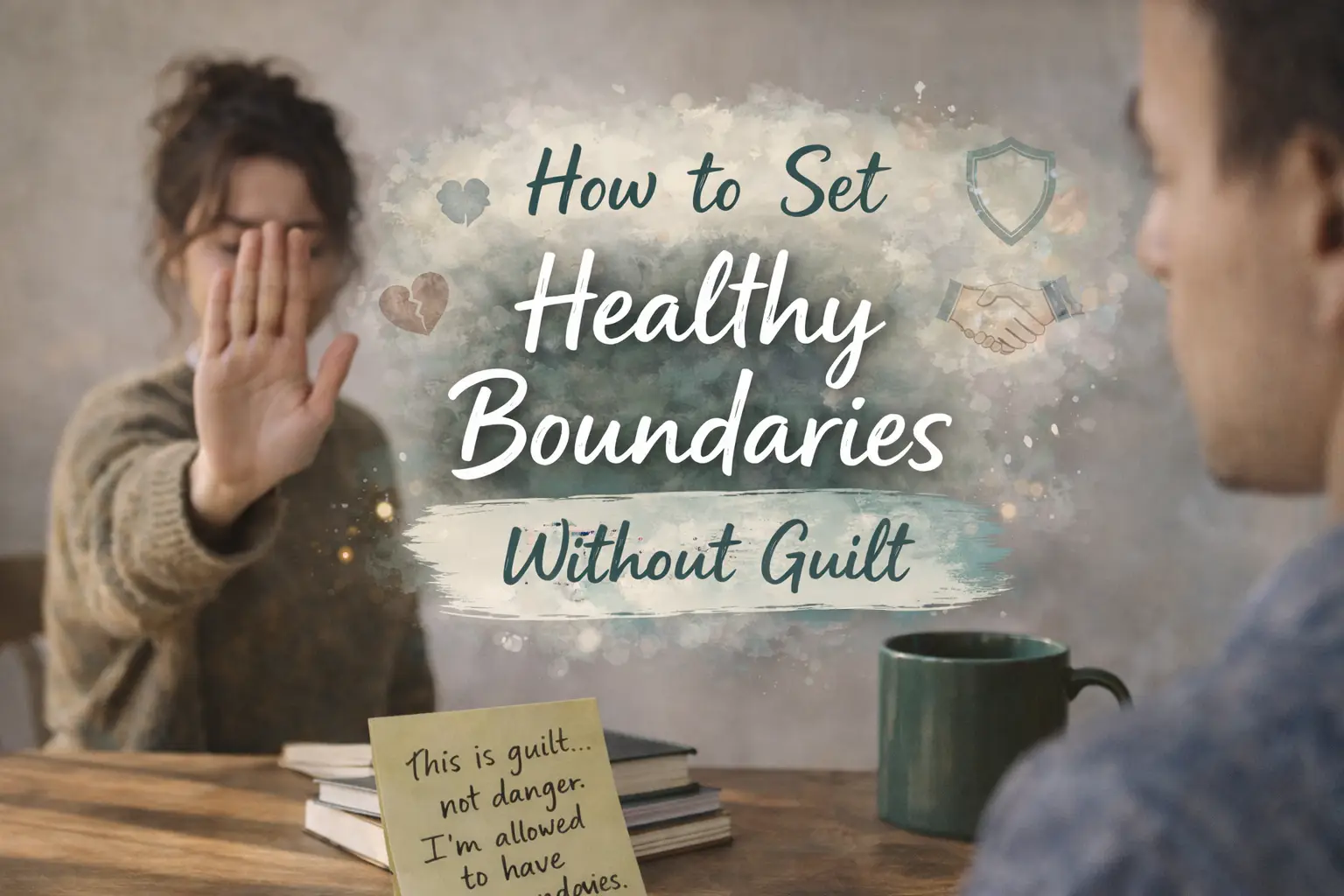
    A woman calmly raises her hand in a stop gesture while speaking to someone across a table.
    Boundaries can be firm, clear, and respectful at the same time.

    Daring to set boundaries is about having the courage to love ourselves even when we risk disappointing others.


    Why Boundaries Can Feel So Hard After Trauma

    For trauma survivors, boundaries can activate the nervous system.

    When you consider declining or speaking up, your body may react as if danger is imminent. You might feel your heart pound. You might feel your stomach sink. You might be at a loss for words. You might feel unsteady. You might feel compelled to joke or retreat.

    This is not because boundaries are inappropriate. It is because your nervous system has learned that boundaries carry consequences.

    If you have been punished for voicing needs, your body may associate boundaries with threat. If you have been blamed for disputes, you may fear that establishing a limit will make you responsible for problems. If you have been abandoned or rejected after asserting yourself, you may fear that boundaries will result in loss of affection.

    A distressed woman covers her ears while a man shouts at her indoors.
    Unhealthy dynamics can make boundaries feel frightening and unsafe.
    A person writes a list of personal boundaries in a notebook on a wooden table.
    Writing down your boundaries can help bring clarity and confidence.

    These fears are not irrational. They are rooted in experience. Even if your current relationships are safer, your nervous system may still react with old protective responses.

    This is why boundaries are not just a communication skill. They are also a safety skill.


    Why Guilt Shows Up So Fast

    A woman sits at a table looking worried while notes around her reflect guilt and fear after saying no.

    Guilt is a powerful emotion. It can stop you from protecting yourself even when you need to.

    For trauma survivors, guilt often appears for a few reasons.

    One reason is conditioning: if you grew up being called selfish for having needs, guilt becomes automatic. Another is responsibilityโ€”many survivors were forced to manage other peopleโ€™s moods and learned that keeping others happy was their job. Now, setting a boundary can trigger guilt because you are no longer doing that job.

    Another reason is fear. Sometimes guilt is not genuine guilt. It is fear disguised as guilt. It is the nervous system warning, โ€œThis might not be safe.

    It also helps to recognise that guilt can come from empathy. If you care about others, you may naturally notice how your boundary affects them. That is not a bad thing. The issue is when empathy becomes self-abandonment.

    Healthy boundaries allow compassion without losing yourself.

    Healthy Boundaries and Kindness Can Exist Together

    Many people fear that boundaries make them cold.

    This fear is understandable, especially if you have spent a lifetime being โ€œniceโ€ to stay safe. If you have survived by being agreeable, boundaries can feel like cruelty.

    But boundaries are not harsh. They are certain.

    It is possible to be kind and say no, to care and need space, to be loving and still protect yourself.

    In fact, boundaries often make relationships healthier. Without boundaries, resentment builds. Burnout happens. People feel unseen. Over time, relationships can break down, not because anyone is bad, but because limits were never honoured.

    Boundaries keep relationships honest. They allow steadier closeness, rather than one that drains you.

    The Difference Between a Request and a Demand

    This is an important shift in boundary work.

    A request is something someone can ask for, but you can say yes or no. A demand is something that comes with punishment if you say no.

    Trauma can blur this difference. If you have lived in controlling environments, your nervous system may treat every request like a demand. Someone asks for your time, and your body reacts as if you must provide it. Someone asks you to talk, and your body reacts as if you have no choice. Someone wants help, and your body reacts as if saying no is dangerous.

    Part of healing is teaching your nervous system that you now have a choice.

    You are allowed to pause. You are allowed to think. You are allowed to say no.

    If someone punishes you for saying no, that is not a request. That is control.

    Trauma-Informed Boundaries Start With Awareness

    Before you set boundaries with others, it helps to notice where you struggle.

    Some people struggle with time boundariesโ€”replying too fast, saying yes too quickly, and becoming overwhelmed. Others struggle with emotional or physical boundaries, taking on feelings or tolerating discomfort, which can leave them drained.

    A trauma-informed approach starts with noticing your body.

    When someone asks you for something, what happens inside? Do you feel pressure to agree? Do you feel anxious? Do you feel a sinking feeling? Do you feel dread? Do you feel tightness in your chest?

    These signals are not random. They are information. They can help you recognise when a boundary is needed.

    Many survivors were taught to ignore their bodies. Boundary work often involves learning to listen to it again.

    The Pause: A Simple Tool That Changes Everything

    One of the most effective boundary tools is the pause.

    People-pleasing often happens quickly. The yes comes out before you have checked in with yourself. You may agree automatically and later feel regret.

    The pause interrupts that pattern.

    Instead of answering right away, you can say, โ€œLet me think, and Iโ€™ll get back to you,โ€ โ€œIโ€™ll check my diary,โ€ โ€œIโ€™m not sure yet,โ€ or โ€œCan I let you know later?โ€

    This pause gives your nervous system time to settle. It gives your true answer time to appear. It also teaches others that your time and energy are valuable.

    You do not owe an instant reply.

    Gentle Ways to Say No Without Over-Explaining

    Many trauma survivors feel they must justify their no.

    They worry that if they do not provide a good enough reason, they will be rejected or attacked. So they over-explain. They apologise repeatedly. They give long stories. They offer alternatives that they cannot manage.

    Over-explaining often comes from fear.

    Healthy boundaries can be simple.

    You can say, โ€œI canโ€™t do that.โ€

    You can say, โ€œThat doesnโ€™t work for me.โ€

    You can say, โ€œIโ€™m not available.โ€

    You can say, โ€œI need rest.โ€

    You can say, โ€œI canโ€™t commit to that.โ€

    You can also add warmth without overdoing it. You might say, โ€œThank you for asking, but I canโ€™t.โ€ You might say, โ€œI care, but I need some time to myself.โ€ You might say, โ€œIโ€™m keeping things simple at the moment.โ€

    You do not have to convince someone. In healthy relationships, your no is enough.

    No is a complete sentence

    Boundaries Are About Actions, Not Arguments

    A boundary is strongest when it focuses on what you will do.

    Instead of arguing or explaining for a long time, you can calmly state your limit and what will happen next.

    For example, you might say, โ€œIโ€™m not able to talk about that topic. If it comes up, I will change the subject or end the call.โ€ You might say, โ€œI donโ€™t take calls after 8pm. If you call then, Iโ€™ll reply the next day.โ€

    This is not harsh. It is clear.

    If you have been in relationships where your words were ignored, action-based boundaries can feel safer. You are not begging someone to respect you. You are taking care of yourself.

    Handling Guilt When You Set a Boundary

    Even when you set a boundary kindly, guilt may still appear.

    It helps to remember that guilt is not always a sign of wrongdoing. Sometimes guilt is a sign that you are breaking an old rule, such as โ€œMy needs donโ€™t matterโ€ or โ€œI must keep everyone happy.โ€

    You can work with guilt by naming it softly. You might tell yourself, โ€œThis is guilt, not danger.โ€ You might tell yourself, โ€œIt is okay to feel guilty and still keep my boundary.โ€ You might tell yourself, โ€œMy body is learning something new.โ€

    You can also remind yourself of the cost of not having boundaries. Without boundaries, you may become exhausted. You may become resentful. You may withdraw. You may lose your energy and joy. Boundaries protect your long-term well-being.

    Guilt may feel uncomfortable, but discomfort is not the same as harm.

    What If Someone Dislikes Your Boundary?

    This is one of the hardest parts.

    Some people will not like your boundaries. That does not automatically mean you are wrong.

    Disappointment is a normal emotion. People can feel disappointed and still respect you. A healthy person may say, โ€œOkay,โ€ even if it is not what they wanted.

    If someone reacts with anger, guilt-tripping, insults, threats, or the silent treatment, that is not a healthy way to handle disappointment. That is manipulation or control.

    Trauma survivors often fear reactions because reactions used to mean danger. It can help to watch for behaviour rather than feelings.

    A safe person respects your boundary. An unsafe person punishes you for it.

    You deserve relationships where you can be a full human being, not just a helper.

    Boundaries in Close Relationships

    Many people find it hardest to set boundaries with partners, family, or close friends.

    These relationships can carry history. They can also carry expectations. You may fear losing connection. You may fear being seen as ungrateful. You may fear being labelled selfish.

    In close relationships, boundaries often work best when they are calm and consistent.

    If you set a boundary one day and drop it the next, your nervous system stays unsettled, and others may become confused as well. Consistency helps everyone adjust.

    It can also help to name the boundary as a form of care. You might say, โ€œIโ€™m setting this boundary because I want our relationship to feel healthy.โ€ You might say, โ€œIโ€™m doing this so I donโ€™t burn out.โ€ You might say, โ€œI care about you, and I need rest too.โ€

    Healthy people can usually hear this.

    Boundaries With Yourself Matter Too

    Trauma-informed boundaries are not only about other people. They are also about you.

    You may need boundaries around your own habits, especially if you tend to push yourself too hard.

    This might include resting before you crash. It might include limiting doom-scrolling or overworking. It might include saying no to your own inner critic when it tells you you must prove your worth.

    You can practise self-boundaries by asking, โ€œWhat is realistic for me today?โ€ and โ€œWhat would support my body right now?โ€

    This is not laziness. It is nervous system care.

    Boundaries Are a Form of Healing

    Every time you set a boundary, you send your nervous system a message.

    You are telling yourself, โ€œI matter.โ€

    You are telling yourself, โ€œI am allowed to have limits.โ€

    You are telling yourself, โ€œI do not have to earn rest.โ€

    You are telling yourself, โ€œI can protect myself now.โ€

    This is powerful, especially for survivors who were not protected in the past.

    Boundaries can feel shaky at first. That is normal. Healing often feels awkward at the beginning because it is new.

    With time and practice, boundaries begin to feel less like conflict and more like self-respect.

    Final Thoughts

    Healthy boundaries are not selfish. They are necessary.

    If guilt shows up when you set a limit, it does not mean you are doing something wrong. It often means you are doing something different from what you had to do in the past.

    You are allowed to say no. You are allowed to rest. You are allowed to protect your time, energy, and emotional space. You are allowed to have relationships that do not depend on you overgiving.

    Boundaries are not about pushing people away. They are about letting people be close to you in a way that feels safe.

    And you do not have to learn this alone.

    Thank you for taking the time to read my blog. If it resonated with you, please consider sharing it so others may benefit too.

    And always remember, you are not alone.


  • Building Trust Again: Small Steps That Make a Big Impact

    Building Trust Again: Small Steps That Make a Big Impact

    Lana Elliott

    Through both her coaching and her writing, Lana aims to create spaces where people feel seen, heard, and supported as they begin to heal and move forward.

    Trust forms the foundation of every meaningful relationship, whether personal or professional. When it is gone, it can feel daunting to think about rebuilding trust instead of focusing on what youโ€™ve lost. But with patience, steady effort, and the right approach, it is possible to form connections that are even stronger than before.
    Understanding

    Trust: Why It Matters So Much


    Trust isnโ€™t just a nice thing to have in relationships; itโ€™s essential for our emotional well-being and mental health. When trust is damaged, our nervous system can react as if weโ€™re under threat, making it harder to feel safe and secure with others.


    Recognising that breaks in trust can trigger old wounds is essential. This awareness helps us approach rebuilding with compassion rather than frustration.
    Trust grows through small, repeated actions rather than big, dramatic gestures

    Hands hold a paper heart that has been torn and taped back together.
    Healing after hurt can be messy, careful, and deeply human.

    Building trust is a process. Trust results from consistent and predictable interaction over time.


    The Science Behind Trust Building


    Research shows that trust grows through small, repeated actions rather than big, dramatic gestures. Neuroscientist Paul Zakโ€™s work suggests trust increases oxytocin production. Often called the โ€œbonding hormone, ” Oxytocin helps us feel calmer and more connected. Helping us better understand other peopleโ€™s feelings.


    Other studies also show that our brains look for patterns when deciding whether to trust someone. When someone behaves steadily and predictably, our nervous system learns that it is safe to relax. This lowers stress hormones like cortisol, making it easier for us to open up and build healthy relationships.


    Trust-building is linked to โ€œco-regulationโ€. This means that when we feel safe with another person, our bodies naturally start to calm down by picking up on their tone of voice, facial expressions, and gestures. Over time, these small moments help rebuild a sense of safety, even after trust has been broken.


    Small Steps That Create Big Changes

    Start with Self-Trust

    Before rebuilding trust with others, it’s vital to cultivate trust within yourself. This means:

    Practising self-compassion: Treat yourself with the same kindness you’d show a good friend

    Keeping promises to yourself: Follow through on commitments you make to yourself.

    Honouring your boundaries: Respect your own limits and communicate them clearly.

    Before rebuilding trust with others, it’s vital to cultivate trust within yourself. This means:

    • Keeping promises to yourself: Follow through on commitments you make to yourself.
    • Honouring your boundaries: Respect your own limits and communicate them clearly.
    • Practising self-compassion: Treat yourself with the same kindness you’d show a good friend

    2. Master the Art of Micro-Commitments

    Large promises can feel overwhelming and increase pressure. Instead, focus on tiny, achievable commitments:

    • Arriving exactly when you say you will
    • Responding to messages within the timeframe you’ve promised
    • Following through on small tasks consistently

    These micro-commitments create a foundation of reliability that gradually rebuilds confidence.

    3. Embrace Radical Honesty (With Kindness)

    Honesty is non-negotiable in trust building, but it must be delivered with care:

    • Be truthful about your limitations: “I’m not sure I can commit to that right now”
    • Acknowledge mistakes quickly: Address errors before they compound
    • Share your feelings appropriately: Express emotions without overwhelming others

    4. Practice Active Listening

    Trust grows when people feel truly heard and understood:

    • Put away distractions during conversations
    • Reflect what you’ve heard: “It sounds like you’re feeling…”
    • Ask clarifying questions to show genuine interest
    • Avoid immediately offering solutions unless asked

    5. Create Predictable Patterns

    Consistency builds trust more effectively than perfection. Establish reliable patterns in:

    • Communication: Regular check-ins or updates
    • Behaviour: Consistent responses to similar situations
    • Availability: Clear boundaries around when you’re accessible


    The process of rebuilding trust is not a single, grand gesture but a journey made up of these small, consistent actions. Each apology, each commitment kept, and each moment of transparency serves as a positive data point, slowly replacing the negative ones that caused the initial break. By focusing on these manageable steps, you shift the narrative from the damage of the past to the hopeful construction of a more resilient, honest future, one small act of trust at a time.

    Trust-Building Exercises for Relationships

    The Weekly Trust Check-In

    Set aside 15 minutes weekly to discuss:

    • What actions built trust this week?
    • What moments felt challenging?
    • What would feel supportive moving forward?

    The Appreciation Practice

    Daily, share one specific thing you appreciated about the other person’s trustworthy behaviour. This reinforces positive patterns and builds emotional safety.

    The Transparency Exercise

    Choose one area where you could be more open and gradually increase vulnerability. Start smallโ€”perhaps sharing a minor worry or hope.

    Navigating Setbacks: When Trust Feels Fragile

    Rebuilding trust isn’t linear. Expect setbacks and approach them with curiosity rather than judgement:

    • Normalise the process: Healing isn’t straightforward
    • Return to basics: Go back to simple, consistent actions
    • Seek support: Consider professional guidance when needed

    Creating Boundaries That Build Trust

    Healthy boundaries actually enhance trust by:

    • Providing clear expectations
    • Preventing resentment from building
    • Demonstrating self-respect and other-respect

    Remember: saying “no” to preserve your well-being is a trustworthy act.

    The Role of Time and Patience

    Trust building operates on emotional time, not calendar time. Some days will feel like significant progress, others like you’re moving backwards. This is normal and part of the healing process.

    Research suggests it takes an average of 66 days to form a new habit. Rebuilding trust in relationships often takes much longer. Sometimes a matter of months or even years, depending on the situation.

    When to Seek Professional Support

    Consider working with a trauma-informed life coach or therapist when:

    • Trust issues stem from past trauma
    • You’re struggling with consistent self-sabotage
    • Communication feels stuck in negative patterns
    • You need support in processing complex emotions

    Moving Forward: Bridging The Gap

    Building trust again isn’t about returning to where you were; it’s about moving forward. It’s an opportunity to create deeper, more authentic connections. The small steps you take today become the foundation for the relationships you’ll enjoy tomorrow.

    Remember that choosing to rebuild trust is a courageous act. It requires vulnerability, patience, and faith in the possibility of healing. Every small step matters, and each consistent action builds momentum. So just keep taking those small steps.

    Building trust is an art and a science. It requires both emotional intelligence and practical strategies. By focusing on small, consistent actions rather than overwhelming yourself with pressure to “fix everything at once,” you create sustainable, lasting change.

    Thank you for taking the time to read my blog. If it resonated with you, please consider sharing it so others may benefit too.

    And always remember, you are not alone.


Solverwp- WordPress Theme and Plugin