Category: Domestic Abuse

  • When Debt Isnโ€™t Yours: 10 Signs of Financial Abuse and What You Can Do About It.

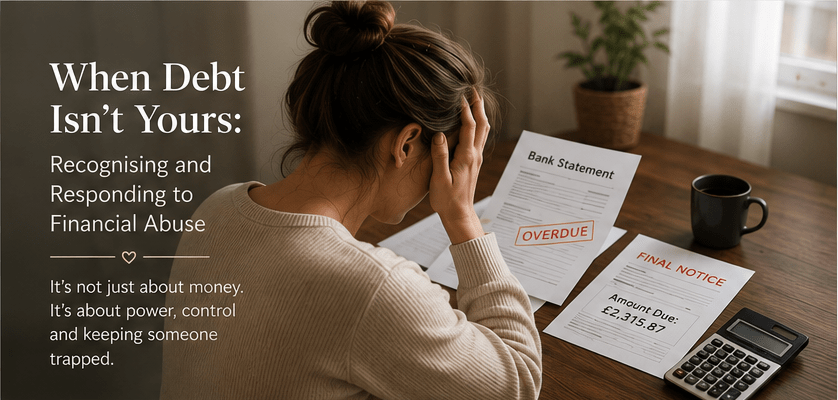
    When Debt Isnโ€™t Yours: 10 Signs of Financial Abuse and What You Can Do About It.


    Financial abuse is one of the most hidden forms of domestic abuse.

    It does not always look dramatic from the outside. It may not involve visible injuries. It may not begin with someone taking every penny from your account. Sometimes it starts with โ€œIโ€™ll look after the money.โ€ Sometimes it sounds like โ€œYouโ€™re useless with spending.โ€ Sometimes it is a loan, a phone contract, a car finance agreement, a joint account, a missed payment, or a bill you were told not to worry about until it lands in your name.


    But financial abuse is not really about money.
    It is about power, control, freedom and safety.


    In July 2026, Refuge reported a 78% rise in referrals involving technology-facilitated abuse and economic abuse, including growing concerns around perpetrators exploiting car finance agreements and leaving survivors in serious debt. UK charities, including Refuge and Surviving Economic Abuse, have warned that perpetrators are increasingly using loans, finance, digital tools and credit systems as part of coercive control.
    This matters because financial abuse can keep someone trapped long after the relationship has ended. It can affect housing, credit scores, employment, confidence, mental health and the ability to rebuild safely.


    If you have ever thought, โ€œBut the debt is in my name, so maybe it is my fault,โ€ this article is for you.


    What is financial abuse?


    Financial abuse, also known as economic abuse, happens when someone uses money, debt, property, employment, benefits, bills, transport, technology or financial systems to control another person.


    Surviving Economic Abuse explains that economic abuse is a legally recognised form of domestic abuse in England and Wales under the Domestic Abuse Act 2021. It involves control over money and finances, but also the things money can buy, such as housing, food, transport, phones and everyday essentials.


    It can happen during a relationship, after separation, within marriage, between ex-partners, or within family relationships. It can happen alongside emotional abuse, coercive control, physical abuse, sexual abuse or technology-facilitated abuse.
    It can also be very difficult to explain.


    A survivor may say:


    โ€œI donโ€™t know how it happened.โ€
    โ€œI thought I agreed to it at the time.โ€
    โ€œThey said it was for us.โ€
    โ€œI was scared to say no.โ€
    โ€œI didnโ€™t understand what I was signing.โ€
    โ€œThey told me I would ruin everything if I refused.โ€
    โ€œI thought I was helping.โ€


    This is why trauma-informed understanding matters. Financial abuse is not always a neat, simple story. It is often built through fear, pressure, manipulation, shame and confusion.


    Why financial abuse is often missed


    Financial abuse is often missed because people still have a narrow idea of what domestic abuse looks like.


    Many people picture shouting, bruises or police call-outs. They may not picture someone being prevented from working. They may not notice a partner monitoring bank transactions. They may not recognise the danger in someone being forced to take out credit, hand over benefits, justify every purchase, or carry debt for something they did not freely choose.


    The Home Office and Surviving Economic Abuse published figures in June 2026 showing gaps in public understanding, including that younger men were more likely than older men to fail to recognise controlling how someone spends money as abuse.
    That gap matters. If people do not recognise financial control as abuse, survivors are more likely to blame themselves. Friends and family may dismiss it as โ€œrelationship problemsโ€ or โ€œbad budgeting.โ€ Professionals may focus only on the debt rather than the coercion behind it.


    Financial abuse is not poor money management when someone else has been controlling, pressuring, threatening or sabotaging your financial choices.
    It is abuse.


    10 signs of financial abuse


    Financial abuse can look different in every relationship, but these are common warning signs.


    1. They control access to money


    This might mean they hold the bank cards, control online banking, decide what you are โ€œallowedโ€ to spend, or give you small amounts of money while keeping the rest.
    You may have to ask for basic things. You may feel anxious buying food, toiletries, petrol, clothes for the children, medication or anything for yourself.
    The issue is not whether a couple has shared finances. Many couples do. The issue is whether one person has choice, information and freedom, while the other person has control.


    2. They monitor or question every purchase


    Some perpetrators demand receipts, check bank apps, look through messages, question every transaction or accuse the survivor of lying.
    This can leave someone feeling watched all the time.
    Even small purchases can become frightening because the survivor knows there may be an argument, punishment, silent treatment, threats or accusations later.


    3. They stop you from working, studying or becoming independent


    Financial abuse may involve stopping someone from going to work, sabotaging childcare, causing arguments before shifts, hiding keys, interfering with study, or making it impossible to keep a job.
    Sometimes it is direct: โ€œYouโ€™re not working.โ€
    Sometimes it is disguised as care: โ€œYou donโ€™t need to work. Iโ€™ll look after you.โ€
    Sometimes it is emotional pressure: โ€œIf you loved me, youโ€™d stay home.โ€
    The result is the same. Your independence becomes smaller.


    4. They take out credit, loans or finance in your name


    This can include loans, credit cards, overdrafts, phone contracts, catalogues, car finance agreements or other forms of borrowing.
    Sometimes the survivor is pressured to apply. Sometimes they are misled. Sometimes they sign because they are scared of what will happen if they refuse. Sometimes the debt is taken without full understanding or genuine consent.
    Surviving Economic Abuse describes coerced debt as debt caused by an abusive partner or ex-partner, or debt someone has been forced to take on because of abuse.
    This is one of the reasons the phrase โ€œdebt in your nameโ€ does not always tell the full story.


    5. They use technology to control your finances


    Technology-facilitated abuse can include monitoring banking apps, tracking spending, accessing emails, using passwords, controlling phone accounts, checking location, or using digital tools to intimidate or restrict someone.
    Refuge has a specialist tech safety resource for people worried about issues such as phone monitoring, online stalking or digital abuse by a partner or ex-partner.
    Technology can make abuse feel constant because the perpetrator does not need to be physically present to keep control.


    6. They build debt and then blame you for it


    A perpetrator may pressure someone into debt, spend money, refuse to contribute, drain joint funds, or create financial chaos โ€” then blame the survivor.
    They may say:
    โ€œYou agreed to it.โ€
    โ€œYouโ€™re the reason weโ€™re in this mess.โ€
    โ€œYouโ€™re useless with money.โ€
    โ€œNo one will believe you.โ€
    This can cause deep shame. It can also make survivors delay seeking help because they feel embarrassed or afraid of being judged.
    StepChange reported in March 2026 that seven in ten victim-survivors did not seek help with coerced debt, with shame, embarrassment and not knowing what help was available among the reasons given.
    That statistic is important because it shows how silence protects the abuse, not the survivor.


    7. They control benefits, wages or household income


    Financial abuse can involve taking someoneโ€™s wages, benefits, child maintenance or other income. It may also include forcing them to transfer money, open accounts, hand over cards, or explain why they need access to their own money.
    For survivors who rely on benefits, disability support, carersโ€™ allowance, child benefit or other income, this can create a serious safety risk. Losing access to money can mean losing access to transport, food, medication, phone credit, appointments and escape options.


    8. They use money to punish you


    Money may be used as a reward or punishment.
    The perpetrator might withhold money after an argument, refuse to pay bills, cancel cards, stop paying rent, threaten to leave you with debt, or make you beg for essentials.
    This is not a normal disagreement about budgeting. It is control.


    9. They make it harder for you to leave


    Financial abuse is one of the reasons leaving can be so difficult.
    A survivor may not have savings, transport, access to documents, a safe phone, a good credit score, secure housing or enough money to get through the first few days. They may be carrying debt they did not freely choose. They may fear homelessness, court action, debt collectors, losing the car, or being unable to provide for children.
    This is why comments like โ€œWhy didnโ€™t you just leave?โ€ are harmful.
    Leaving is not only an emotional decision. It can be a financial, legal, housing and safety issue.


    10. They continue financial abuse after separation


    Financial abuse does not always stop when the relationship ends.
    Post-separation abuse can involve refusing to pay agreed costs, using child maintenance as control, dragging out legal processes, leaving joint debts unpaid, sending abusive payment references, damaging credit scores or using shared financial responsibilities to maintain contact.


    Recent UK banking changes show that this is being taken more seriously. For example, Nationwide introduced measures allowing customers to hide harmful messages sent through payment references, after concerns that abusers were using banking systems to continue harassment.
    This matters because abuse can continue through systems that were not designed with survivor safety in mind.


    Why financial abuse affects trauma and mental health


    Financial abuse does not only affect bank accounts.


    It can affect the nervous system, confidence, decision-making and sense of self.
    Someone experiencing financial abuse may feel constantly on edge. They may panic when a bill arrives. They may avoid opening letters. They may feel sick when checking their bank account. They may struggle to make decisions because every decision has previously been criticised, monitored or punished.


    They may also experience shame.


    Shame is one of the most powerful tools in abuse. If someone feels ashamed, they are less likely to tell anyone. If they feel responsible for the debt, they may not ask for help. If they believe professionals will judge them, they may stay silent until the situation becomes urgent.


    A trauma-informed response does not begin with โ€œWhy did you sign it?โ€ or โ€œWhy didnโ€™t you leave?โ€


    It begins with:
    โ€œWhat pressure were you under?โ€
    โ€œWhat did you feel would happen if you said no?โ€
    โ€œWho had the power in that situation?โ€
    โ€œWhat support would help you feel safer now?โ€


    This does not remove responsibility from financial systems, lenders, agencies or perpetrators. It simply puts the survivorโ€™s experience back into context.


    What to do if this sounds familiar


    If any of this sounds familiar, you do not need to have all the answers today.
    You do not need to prove everything before you deserve support.
    You do not need to wait until the situation is โ€œbad enough.โ€


    Financial abuse can be confusing because it often happens gradually. You may only recognise it once you are exhausted, frightened, in debt, isolated or trying to rebuild.
    Here are some safer first steps to consider.


    Notice the pattern


    Try to look at the pattern rather than one single incident.
    Ask yourself:


    Do I feel free to make financial choices?
    Do I have access to my own money?
    Am I scared of their reaction when I spend money?
    Have I been pressured into debt, finance or contracts?
    Do they use money to control, punish or monitor me?
    Has my financial situation become worse because of their behaviour?


    You do not have to label everything immediately. Noticing the pattern can be the first step.


    Keep records where it is safe


    If it is safe to do so, keep records of messages, bank statements, agreements, threats, payment references, debts, contracts or anything that shows pressure or control.
    Do not do this if it increases your risk. If someone monitors your phone, email, cloud storage or online banking, speak to a specialist service about safer ways to keep information.


    Get specialist advice


    Economic abuse can involve domestic abuse support, debt advice, legal advice, housing advice and safety planning.


    Womenโ€™s Aid lists the Financial Support Line for Victims of Domestic Abuse, run by Surviving Economic Abuse and Money Advice Plus, as a specialist service for the financial side of domestic abuse.


    Surviving Economic Abuse also provides information for people experiencing coerced debt, including options around debt and credit reports.


    If you are in immediate danger, call 999.


    Avoid confronting the perpetrator without support


    It can be tempting to challenge them once you recognise the abuse.
    But if someone is controlling, confrontation can increase risk.
    A safer approach may be to speak to a domestic abuse service, debt adviser, solicitor, trusted professional or helpline before making changes they may notice.
    Safety comes before speed.


    Remember that shame is not proof of fault


    Many survivors feel ashamed because the debt is in their name, because they stayed. They signed something, because they did not understand what was happening, or because they feel they โ€œshould have known.โ€
    But coercion changes the meaning of choice.


    A decision made under fear, pressure, manipulation, exhaustion or threat is not the same as a free decision.


    You are allowed to seek help even if the paperwork looks complicated.
    You are allowed to say, โ€œThis was not as simple as it looks.โ€


    Why professionals need to understand financial abuse


    Financial abuse is not only something survivors need to recognise. Professionals need to recognise it too.


    That includes coaches, writers, healthcare workers, debt advisers, housing teams, social care professionals, therapists, bank staff, HR teams, legal professionals and anyone supporting people in crisis.


    The UK Governmentโ€™s Economic Abuse Toolkit for public sector creditors says that noticing the signs and offering consistent, effective support can have a significant impact on someoneโ€™s safety and economic stability.
    That sentence matters.


    It means the response someone receives can either increase shame or reduce it. It can either focus only on the debt or ask what caused it. It can either treat someone as irresponsible or recognise that abuse may have restricted their choices.


    A trauma-informed professional response should be:
    curious, not blaming;
    clear, not overwhelming;
    practical, not dismissive;
    safety-aware, not rushed;
    respectful of choice, not forceful.


    Someone experiencing financial abuse may already have been told they are stupid, careless, dramatic, irresponsible or impossible to help. Professionals must not repeat the perpetratorโ€™s message in a different voice.


    Where to get financial abuse support in the UK


    If you are experiencing domestic abuse or financial abuse, you deserve support that understands the risk and complexity.
    Useful UK starting points include:


    Refuge and the 24-hour National Domestic Abuse Helpline. https://refuge.org.uk/i-need-help-now/how-we-can-help-you/our-refuges/


    Surviving Economic Abuse for information on economic abuse, coerced debt and financial safety.


    Womenโ€™s Aid for survivor information and routes to specialist support. https://womensaid.org.uk/


    The Financial Support Line for Victims of Domestic Abuse, run by Surviving Economic Abuse and Money Advice Plus, for specialist financial guidance.


    NHS guidance on getting help for domestic violence and abuse also explains that domestic abuse can include physical, emotional and sexual abuse, and can happen in close or trusted relationships.


    If you are in immediate danger, call 999.


    If it is not safe to search for support on your own device, consider using a safer device, clearing browsing history, using a trusted professional, or contacting a specialist domestic abuse service for tech safety guidance.


    Final thoughts


    Financial abuse is not โ€œjust money.โ€


    It can affect where you live, how safe you feel, whether you can leave, whether you can work, whether you can feed yourself, whether you can access transport, whether you can answer the phone without fear, and whether you believe a future is possible.
    If debt was created through fear, pressure, control or manipulation, the story is bigger than the balance owed.


    You are not weak for feeling overwhelmed.
    You are not irresponsible for needing help.
    And you are not alone if it has taken time to recognise what was happening.


    At Lana Elliott Wellbeing, I write and speak about trauma, domestic abuse and recovery in a way that keeps the person at the centre. Financial abuse deserves to be understood because survivors deserve more than judgment. They deserve safety, information, choice and support that sees the full picture.

    GENTLE SUPPORT

    You do not have to keep working through it on your own.

    Trauma-informed coaching can offer a calm, supportive space to reflect, rebuild, and move forward at a pace that feels safe for you. You can begin where you are.


    Lana Elliott is a trauma-informed life coach and wellbeing writer. Lana supports adults affected by trauma, difficult life experiences, and domestic abuse through calm, client-led coaching and gentle, trauma-informed resources.


    LANA ELLIOTT WELLBEING

  • More Than Violence
What the Latest UK Domestic Abuse Figures Tell Us

    More Than Violence What the Latest UK Domestic Abuse Figures Tell Us

    Lana Elliott

    Through both her coaching and her writing, Lana aims to create spaces where people feel seen, heard, and supported as they begin to heal and move forward.

    Domestic abuse is more than physical violence โ€” and that matters, because so many people don’t realise what they’re living in until they’ve been living in it for years. Looking back on my own past relationships, I can now see patterns of abuse that at the time were completely invisible to me. There were no bruises. Nothing I could point to and say, “That is what this is.” And that’s exactly what makes it so hard to name. 

    It can include fear, control, threats, emotional abuse, financial abuse, sexual abuse, stalking, isolation, humiliation and coercive control. It can happen in intimate relationships or between family members. And it can affect anyone โ€” women, men, LGBTQ+ people, disabled people, older adults, young people and people from every background, in every kind of household.

    The latest UK domestic abuse figures show how widespread the issue remains. They also show a deeply worrying link between domestic abuse and suicide risk.

    It is important to be clear from the start. The figures do not show that more than half of all domestic abuse cases lead to suicide. That would not be accurate. What the latest figures do show is that, within recorded domestic abuse-related deaths, suspected suicides following domestic abuse are now a major and rising concern.

    In the year ending March 2025, the Crime Survey for England and Wales estimated that 3.8 million people aged 16 and over experienced domestic abuse. That is around 1 in 13 people. The Office for National Statistics also reported that around 12.5 million people aged 16 and over had experienced domestic abuse since the age of 16. That is around 1 in 4 people.

    The Domestic Homicide Project recorded 347 domestic abuse-related deaths in the year to March 2025 โ€” 150 of which were suspected suicides following domestic abuse, and 80 intimate partner homicides. Domestic abuse, in other words, can be life-threatening in ways that don’t always look like what we imagine when we picture danger. 

    Behind every statistic is a person. Someone who may have felt frightened. Someone who may have felt trapped. Someone who may have been controlled, isolated or worn down over time. Someone who deserved safety and support much earlier.

    This article looks at what the latest figures tell us, why domestic abuse can have such a huge impact on mental health, how to recognise the signs, and where people in the UK can get help.

    What counts as domestic abuse?


    Domestic abuse is not just physical violence.

    The NHS explains that domestic violence or abuse can include physical, emotional and sexual abuse in couple relationships or between family members. It can happen to anyone.

    Domestic abuse may include:

    • Threats involving children, pets, housing, money or immigration status
    • Physical violence
    • Threats or intimidation
    • Emotional abuse
    • Sexual abuse
    • Financial or economic abuse
    • Coercive control
    • Stalking
    • Digital monitoring
    • Isolation from friends or family
    • Humiliation
    • Controlling where someone goes, who they see or what they spend


    Some people know they are being abused. Others may feel confused. This is common when the abuse is mainly emotional or controlling.

    A person may think, โ€œThey have never hit me, so maybe it is not abuse.โ€ But abuse does not have to leave a bruise to be real.

    If someone is changing their behaviour because they are scared of another personโ€™s reaction, that matters. If someone feels watched, trapped, blamed or controlled, that matters too.

    two people shouting with letters coming out of their mouths
    Shouting can be abuse


    Domestic abuse will never end until we make it socially unacceptable.


    The latest UK domestic abuse figures


    The latest figures from the Office for National Statistics show that domestic abuse remains a major issue in England and Wales.

    For the year ending March 2025, the Crime Survey for England and Wales estimated that:

    • 3.8 million people aged 16 and over experienced domestic abuse in the last year.
    • This was around 7.8% of people aged 16 and over.
    • Around 2.2 million females and 1.5 million males experienced domestic abuse in the last year.
    • Around 12.5 million people have experienced domestic abuse since the age of 16.

    Police also recorded 1,350,460 domestic abuse-related incidents and crimes in England and Wales in the year ending March 2025. Of these, 816,493 were recorded as domestic abuse-related crimes.

    More information and figures can be found at the Office for National Statistics domestic abuse figures or by following the link below.

    These numbers are already high. But they are unlikely to show the full picture.


    Many people do not report domestic abuse to the Police. Some people are afraid that reporting will make the abuse worse. Some are worried they will not be believed. Some depend on the person harming them for money, housing, transport or childcare. Others may not yet recognise what is happening as abuse.

    Domestic abuse can be hidden for years. It can happen in homes that look calm from the outside. It can happen in relationships that other people think are โ€œnormalโ€. It can happen to people who seem confident, capable and successful.

    a lady upset with a man seemingly comforting her
    Things aren’t always as they seem.
    an idyllic looking home with 2 people arguing inside
    Noone truly knows what happens behind closed doors.


    Domestic abuse and suicide risk


    One of the most concerning findings from the latest domestic abuse-related death figures is the number of suspected suicides following domestic abuse.

    The Domestic Homicide Project recorded 347 domestic abuse-related deaths in the year to March 2025. This included 150 suspected suicides following domestic abuse. Reports also show that suspected suicides following domestic abuse have overtaken intimate partner homicides for the third year in a row.

    This does not mean that suicide is inevitable for survivors of domestic abuse. It is not. Many survivors do rebuild their lives, especially when they have safe support, protection, community and time.

    But the figures do show that domestic abuse can place a person under extreme emotional pressure.

    Abuse can make someone feel:

    • trapped
    • ashamed
    • frightened
    • watched
    • powerless
    • isolated
    • exhausted
    • responsible for the abuserโ€™s behaviour
    • unable to see a safe way forward

    This can be even harder when coercive control is involved.

    Coercive control is a pattern of behaviour. Used to dominate, frighten and limit another personโ€™s freedom. It can include threats, monitoring, isolation, financial control, emotional manipulation and punishment.

    A person living with coercive control may not feel able to make simple choices. They may feel they have to ask permission. They may feel unsafe saying no. They may feel that any attempt to leave will lead to danger, revenge or the loss of everything.

    Over time, this can affect a personโ€™s mental health deeply. It can lead to anxiety, depression, trauma symptoms, panic, sleep problems, shame, hopelessness and suicidal thoughts.

    This is why domestic abuse needs to be taken seriously, even when there are no physical injuries.

    Emotional abuse can be deeply damaging.

    Emotional abuse was the most common type of domestic abuse recorded by the Crime Survey for England and Wales for the year ending March 2025. The ONS reported that around 5.0% of people aged 16 and over experienced emotional abuse in the last year.

    Emotional abuse can include:

    • being constantly criticised
    • being blamed for everything
    • being called names
    • being humiliated in private or public
    • being told no one else would want you
    • being made to doubt your memory
    • being told you are โ€œtoo sensitiveโ€
    • being threatened
    • being ignored or punished with silence
    • being made to feel guilty for having needs
    • being made to feel responsible for the abuserโ€™s mood

    This type of abuse can slowly change how someone sees themselves.

    They may start to believe they are the problem. They may stop trusting their own judgement. They may feel they have to explain, apologise or prove themselves all the time.

    In my work as a trauma-informed life coach, this is one of the patterns I see most often. People arrive not always knowing they’ve been abused โ€” but knowing something has been deeply wrong with how they see themselves. The rebuilding often starts there, with simply being believed.

    Domestic abuse affects women and men.

    Domestic abuse can happen to anyone.

    The ONS estimated that, in the year ending March 2025, 2.2 million females and 1.5 million males experienced domestic abuse in England and Wales. The prevalence rates were 9.1% for females and 6.5% for males.

    Women are more likely to experience certain forms of severe and repeated abuse. Women are also more likely to be killed by a partner or ex-partner. But men can also experience domestic abuse, and their experiences should not be dismissed.

    Male victims may feel shame, fear or confusion. They may worry that people will not believe them. They may fear being laughed at or judged. They may also worry that services are not for them.

    Support is available for male victims too. The Menโ€™s Advice Line offers confidential advice, practical information and non-judgemental support for male victims of domestic abuse. It also welcomes trans and non-binary people who feel this is the right service for them.

    No one deserves abuse. Support should be available to anyone who is being harmed, controlled or frightened.

    Young people and domestic abuse

    Domestic abuse does not only happen in long-term adult relationships.

    The ONS reported that people aged 16 to 19 and 20 to 24 had higher levels of domestic abuse in the last year compared with people aged 25 and over.

    This matters because abuse in young relationships is sometimes minimised. It may be dismissed as jealousy, drama, immaturity or โ€œjust a bad relationshipโ€. But controlling behaviour is serious at any age.

    In young relationships, abuse may look like:

    • checking someoneโ€™s phone
    • demanding passwords
    • tracking someoneโ€™s location
    • pressuring someone sexually
    • threatening to share private images
    • isolating someone from friends
    • making someone prove where they are
    • constant messaging
    • Jealousy presented as love
    • threats of self-harm if the person leaves

    The Domestic Homicide Project has also recorded serious concerns around teenage relationship abuse, including the first formally recorded suspected suicide following teenage relationship abuse, where both the victim and suspect were under 18.

    Young people need clear, safe education about healthy relationships. They need to know that love should not feel like fear. They also need adults who will listen without judgment.

    Why people may not leave straight away

    One of the most harmful questions people ask about domestic abuse is, โ€œWhy didnโ€™t they just leave?โ€

    For me and many others, that shift in question โ€” from blame to curiosity โ€” can change everything. It’s a lifeline for anyone who has spent years feeling like they have to justify themselves. 

    Leaving is not always simple. In some cases, leaving can be the most dangerous time.

    A person may stay because:

    • They are afraid of what the abuser will do
    • They are threatened
    • They have nowhere safe to go
    • They have children
    • They depend on the abuser financially
    • They are worried about pets
    • They fear losing their home
    • They are being monitored
    • They have been isolated from support
    • They feel ashamed
    • They still love the person
    • They hope things will change
    • They have tried to leave before and were pulled back in

    Abuse can also create deep confusion. The same person who causes fear may also apologise, cry, promise change or show kindness afterwards. This can make the survivor feel torn.

    A trauma-informed response does not ask, โ€œWhy didnโ€™t you leave?โ€

    It asks, โ€œWhat made it unsafe or difficult to leave, and what support do you need now?โ€

    A woman sits on the edge of a bed, looking towards a partially open door, representing the fear, uncertainty and difficult choices that can make it hard to leave an abusive relationship.
    Leaving is not always simple. Fear, safety concerns and practical barriers can make walking away from abuse feel far more difficult than people often realise.

    Signs someone may be experiencing domestic abuse

    Someone may not say, โ€œI am being abused.โ€ They may not have the words yet. They may also be afraid the abuser will find out.

    Signs may include:

    • becoming withdrawn
    • cancelling plans often
    • seeming nervous around their partner or family member
    • needing permission to do things
    • having little access to money
    • being constantly checked on
    • unexplained injuries
    • sudden changes in confidence
    • becoming isolated
    • seeming exhausted or numb
    • being afraid to make decisions
    • always apologising
    • changing how they dress or behave
    • appearing anxious about getting home on time
    • saying their partner โ€œdoesnโ€™t likeโ€ certain friends or family members

    These signs do not prove abuse on their own. But they can be a reason to check in gently.

    You might say:

    โ€œIโ€™ve noticed you donโ€™t seem yourself lately. Iโ€™m not here to judge you, but Iโ€™m worried about you. Is anyone making you feel unsafe?โ€

    If they do open up, try not to rush them. Believe them. Stay calm. Let them know the abuse is not their fault.

    Safety planning and online safety

    If someone is experiencing domestic abuse, safety planning can be important.

    A safety plan may include:

    • keeping important documents somewhere safe
    • saving emergency numbers under a different name
    • keeping some money, medication or keys accessible if possible
    • planning where to go in an emergency
    • arranging a code word with a trusted person
    • speaking to a specialist domestic abuse service
    • thinking carefully before telling the abuser you are leaving
    • checking phone, app and location settings if safe to do so

    Online safety also matters.

    Some abusers monitor phones, emails, cloud accounts, social media, banking apps, location sharing, smart devices or search history. The NHS domestic abuse guidance notes that Womenโ€™s Aid provides information on how to cover your tracks online if you are worried someone may see that you have visited a domestic abuse webpage.

    If you are worried you are being monitored, it may be safer to use a trusted friendโ€™s phone, a work device, a library computer or another safe device when looking for help.

    Where to get help for domestic abuse in the UK

    If you are in immediate danger, call 999.

    If you cannot speak and you are calling from a mobile, the Silent Solution system may help. A recorded message will tell callers who cannot talk to press 55 to be put through to the Police.

    National Domestic Abuse Helpline

    The National Domestic Abuse Helpline, run by Refuge, is available on 0808 2000 247. Refuge states that the helpline offers confidential, non-judgemental support and information on your options, day or night.

    NHS domestic abuse guidance

    The NHS domestic abuse guidance explains what domestic abuse can look like, how to recognise signs, and where to get help. It also reminds people that domestic abuse can happen to anyone.

    Menโ€™s Advice Line

    The Menโ€™s Advice Line supports male victims of domestic abuse. It offers confidential advice, non-judgemental support, practical information and help.

    Galop

    Galop supports LGBT+ people experiencing abuse or violence, including domestic abuse, sexual violence, hate crime and other forms of harm. Galop lists its National Helpline for LGBT+ victims and survivors of abuse and violence as 0800 999 5428 and help@galop.org.uk.

    SignHealth Deaf Domestic Abuse Service

    SignHealth provides a specialist domestic abuse and sexual violence service for deaf people. It lists contact details as text only, 07800 003421 and email da@signhealth.org.uk.

    Samaritans

    If you feel unable to cope or are having suicidal thoughts, you can contact Samaritans on 116 123. This number is free to call in the UK.

    Asking for help is not weakness. It is the moment you begin choosing safety, support and yourself.

    How trauma-informed support can help

    Domestic abuse can affect a person long after the relationship or situation ends.

    A survivor may feel anxious, numb, disconnected, guilty, ashamed, angry or exhausted. They may struggle with trust, boundaries, sleep, confidence or decision-making. They may find themselves people-pleasing, over-explaining, freezing during conflict, or feeling responsible for other peopleโ€™s emotions.

    These responses are not signs of weakness. They are often survival responses.

    Trauma-informed support can help people begin to understand what has happened to them without blame. It can help survivors rebuild safety, self-trust and confidence at their own pace.

    This kind of support should never pressure someone to share more than they are ready to share. It should not judge them for staying, leaving, returning, feeling confused or needing time. Healing after abuse is not always simple. It is often a gradual process of feeling safe enough to reconnect with yourself again.

    This is the heart of the work I do with clients. Not rushing the process and not having an agenda for where someone should be. Just creating a space where it feels safe enough to start. 

    Domestic abuse is more than violence.

    Domestic abuse is more than violence.

    It is fear. It is control. It is isolation. It is meant to make you doubt yourself. It is being watched, blamed, threatened or worn down. It is living around someone elseโ€™s moods, reactions and rules.

    The latest UK figures show that domestic abuse remains widespread. They also show that the impact can be devastating, including the risk of suspected suicide following domestic abuse.

    But support is available.

    Something I want every person reading this to hear: you do not have to prove anything before reaching out. Not that it was bad enough. Not that you’re ready to leave. Not that you have a plan. One conversation โ€” just one โ€” can be the thing that changes everything. 

    If someone you care about may be experiencing abuse, you do not have to have all the answers. Listening, believing and helping them connect with specialist support can make a real difference.

    You are not alone. You are not to blame. You deserve safety, support and care. ๐Ÿ’™๐ŸŒฑ

    And always remember, you are not alone.


Solverwp- WordPress Theme and Plugin